Gloucester Township Roofing brings more than 20 years of experience to roofing in Yeadon, where a job usually opens with a question a detached house never raises: where does your roof stop and your neighbor’s begin? On an attached home, that line decides how the old roofing comes off, how the new roofing meets the house next door, and what stays dry afterward.
We treat that line as part of the plan rather than something to sort out on the day. Before anyone climbs up with a pry bar, we want to know what the seam looks like, how the flashing is built, and whether the roof beside yours is sound enough to tie into without trouble for either household.
The pages below walk through how we approach a twin or a row house here: what the building type means for the roof, what we check at the party line, how a re-roof of one half is staged, and why a short conversation with the people next door belongs at the start of the job instead of the middle.
Yeadon’s Twins and Row Houses
A borough that filled in fast
Yeadon, a Delaware County borough incorporated in 1893, grew most of its housing in three decades. The census counted 1,308 residents in 1920, 5,430 in 1930, 8,524 in 1940 and 11,068 in 1950. Census estimates put 2,730 of the borough’s 5,573 housing units in the years before 1950, and 1,508 of those date from 1939 or earlier.
That timeline matters on a roof because houses built in the same push were often built the same way, side by side, by the same hands. A roof put on in that era has usually been redone more than once since, and each round leaves layers, patches and flashing repairs that we have to read before we can plan the next one.
Attached houses are the rule here
The American Community Survey counts 2,381 one-unit attached houses in Yeadon against 953 detached ones, out of 5,573 housing units in all. Among owner-occupied homes the share leans further: 1,572 of the 2,407 owner-occupied homes are attached. For most owners here, a roof job is a job on half of a building, or one link in a row.
An architectural survey of the area groups Yeadon with Colwyn and Collingdale as part of a flood of row houses and small twin houses. We do not assume what any one block looks like from that description. We use it as a reason to ask, on every call, whether the house shares a wall, and then to go look at how that shared wall meets the roof.
What a twin is, in plain terms
The Encyclopedia of Greater Philadelphia describes a twin as at least two dwellings attached to each other, built with one solid wall between them, and notes that twins went up across many communities in Delaware County. That solid wall was quicker and cheaper to raise than a second detached house, which is a big part of why the type spread.
For roofing, the solid wall is the whole story. Two owners, two sets of decisions and often two very different roof histories sit on either side of one masonry line. Your half may carry new architectural shingles while the other half still has a roof from decades ago, and the place where those two meet is where we spend the most care.
Looking for roofing closer to Woolwich? See Roofing in Woolwich.
Where One Roof Meets the Next
The party wall under the roof
A guide written for Philadelphia rowhouses, the city’s own Rowhouse Manual, notes that in older homes party walls do not always extend up to the roof, while some party walls carry the floor and roof framing. It was written about Philadelphia, not Yeadon, but it describes the two conditions we plan for on any older attached house in the region.
We do not know which one we are dealing with on a given Yeadon house until we look. If the party wall stops short, the roof deck may run across the line on shared framing. If the wall carries the rafters, the line sits right on top of masonry. Each case changes where we cut, how we fasten and what we leave untouched.
Reading the seam from above
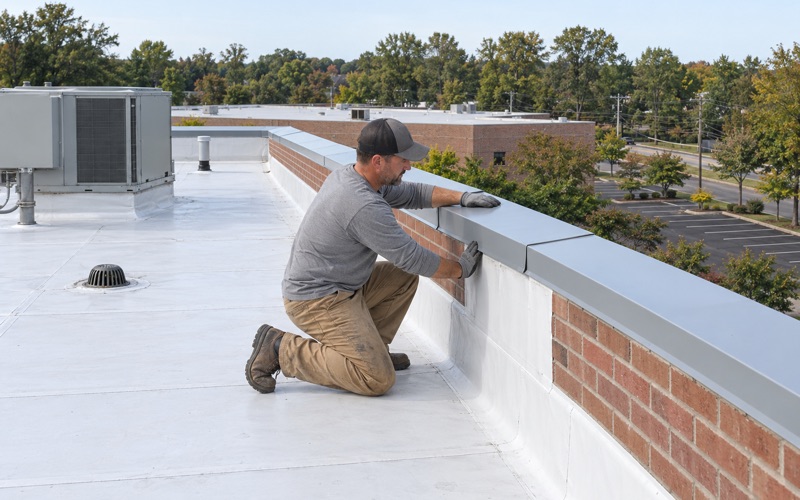
On the roof we start at the party line itself. We look for a raised parapet, a metal cap, a counterflashed joint, a lapped shingle seam with no break at all, or a patched strip of roll roofing laid over years of repairs. Each tells us something about how the last roofer on either side handled the meeting point.
We also note the condition of the roof next door near the line, since our new roofing will lap onto it or butt against it. Brittle shingles, lifted tabs or soft spots on the neighbor’s side are worth knowing about before work starts, because a tie-in can only be as tight as the material it meets.
The attic tells the rest
Outside views only go so far, so every leak call includes a trip into the attic as well as onto the roof. In an attached house, the attic is where we can see whether the party wall rises to the deck, whether light shows through at the line, and where water staining actually starts.
That matters because a stain on your ceiling near the shared wall can begin on the neighbor’s side and travel along a rafter or the top of the masonry. We trace the water to where it enters before anything is priced, so you are not paying to re-roof your half for a leak that starts next door.
Re-Roofing Your Half of a Twin
Repair or replace, answered first
The first thing you get from us is a straight answer on whether the roof can be repaired. Plenty of leaks on an attached house come from one failed piece of flashing or a short run of seam, and fixing that is often the right call. When a full replacement is the honest answer, we explain why in terms you can check.
Tear-off that stops at the line
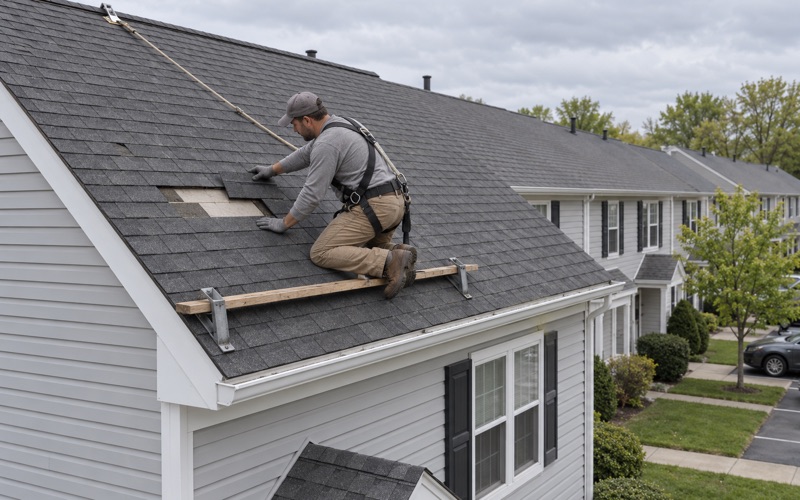
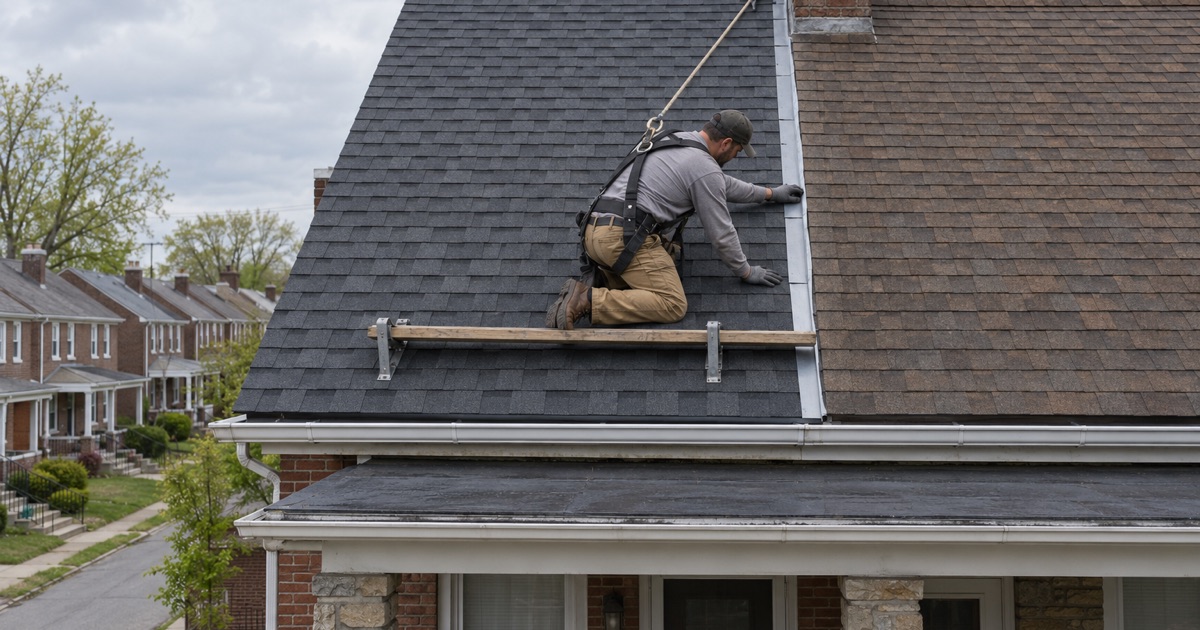
Removing the old roof from one half of a twin is controlled work near the party line. We cut back to a clean edge on your side, protect the neighbor’s roofing from bars and dropped debris, and keep the exposed area as small as possible until the new underlayment is down. Ice and water barrier along the line adds protection right where two roofs meet.
Once the old shingles are off, the decking is finally visible. If any of it has rotted, we photograph it and show you before a single sheet is replaced, and the per-sheet price is already fixed in the contract. On a house this age, that step keeps a surprise from becoming a dispute.
Flashing and the tie-in next door
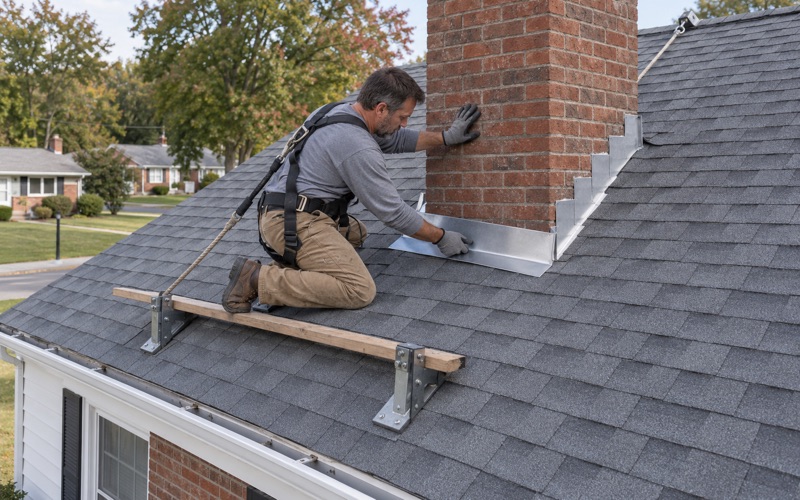
At the party line, the new roof either laps onto the neighbor’s roofing, turns up against a parapet with step flashing and counterflashing, or meets a metal cap. Whichever detail fits, we build it with new metal rather than sealing an old joint over with caulk, which tends to hold for a season and then open again.
The same goes for chimneys, sidewalls and valleys elsewhere on your half. When a roof is redone, those flashings are replaced as part of the job. On a twin, a shared chimney sitting on the party wall gets particular attention, since its flashing has to work with roofing on both sides of the line.
An estimate you can compare
Our written estimates list tear-off, decking, underlayment, flashing, ventilation and gutters on separate lines. On an attached house, the party-line detail sits inside the flashing line where you can see it. If you are collecting more than one bid, that lets you compare like for like instead of trying to match a single lump sum against another.
Talking With the Neighbor Before the Tear-Off
Why that conversation comes first
Nothing about a neighbor conversation is a legal step we are claiming exists. It is practical: the people next door will hear the tear-off, may see crew members near their roof edge, and share the joint that we are about to rebuild. A heads-up before the work starts tends to go better for everyone than a knock on the door during it.
It also helps us. If the neighbor has had leaks near the line, knows of an old repair, or is planning their own re-roof, that changes how we build the tie-in. Sometimes two owners decide to do both halves together; when they do not, we build the joint so the next roofer can meet it cleanly later.
Matching color across a shared roofline
A twin reads as one building from the street, so the new color on your half sits right beside whatever is on the other. We hold shingle samples up against your brick, stone or siding on site, and against the neighbor’s roof in daylight, so the choice is made on the actual house instead of a small chip in a brochure.
Cleanup on both sides
The yard, driveway and gutters are cleaned at the end of every work day, and we run a magnet sweep for roofing nails. On attached houses with shared walks or close driveways, we sweep the neighbor’s side of the line as well, since nails do not respect property lines any more than water does.
Paperwork and storm claims
Yeadon’s own Schedule of Fees lists re-roofing among the building permits the borough issues through its Code and Zoning department at Church Lane and Baily Road, so we plan for that before the work is scheduled. If wind or hail caused the damage, we photograph and write it up for your own insurance claim and will meet your adjuster on site when asked.
- 20+ Years in Business
- Line-Item Written Estimates
- NJ and PA Contracts