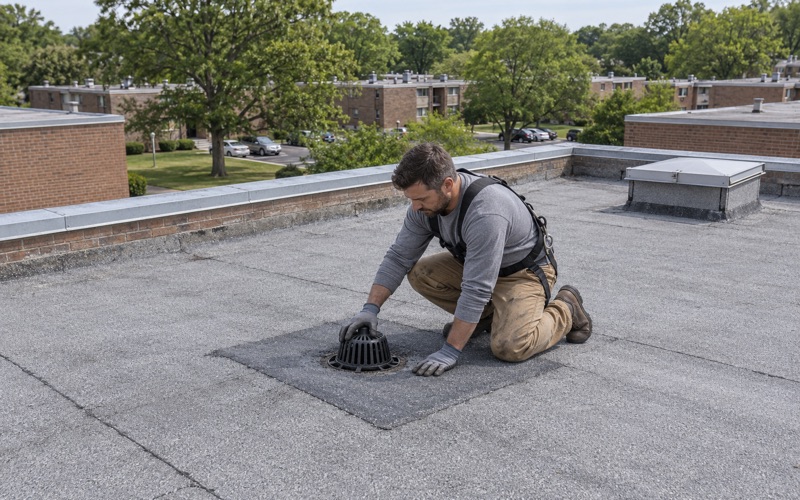
Gloucester Township Roofing has handled roofing in Woolwich and this corner of South Jersey for more than 20 years, and a good share of the calls here come from houses that are barely broken in. When a roof only a year or two old starts to drip, the owner’s first question is rarely about shingles. It is about who should be paying for the fix.
That question has a real answer in New Jersey, and it turns on what let the water in. A leak on a new house may belong to the builder under the state’s new home warranty rules, or it may belong to a storm and the owner’s own insurance. Sorting out which one should come before anyone prices a repair.
Our part is the diagnosis. We go into the attic as well as onto the roof, follow the water back to the spot where it actually enters, and put what we find in writing in plain terms. You leave with an account of the cause to take to whoever is responsible, whether that turns out to be the builder, your insurer or us.
A Township Where the Houses Are Still Going Up
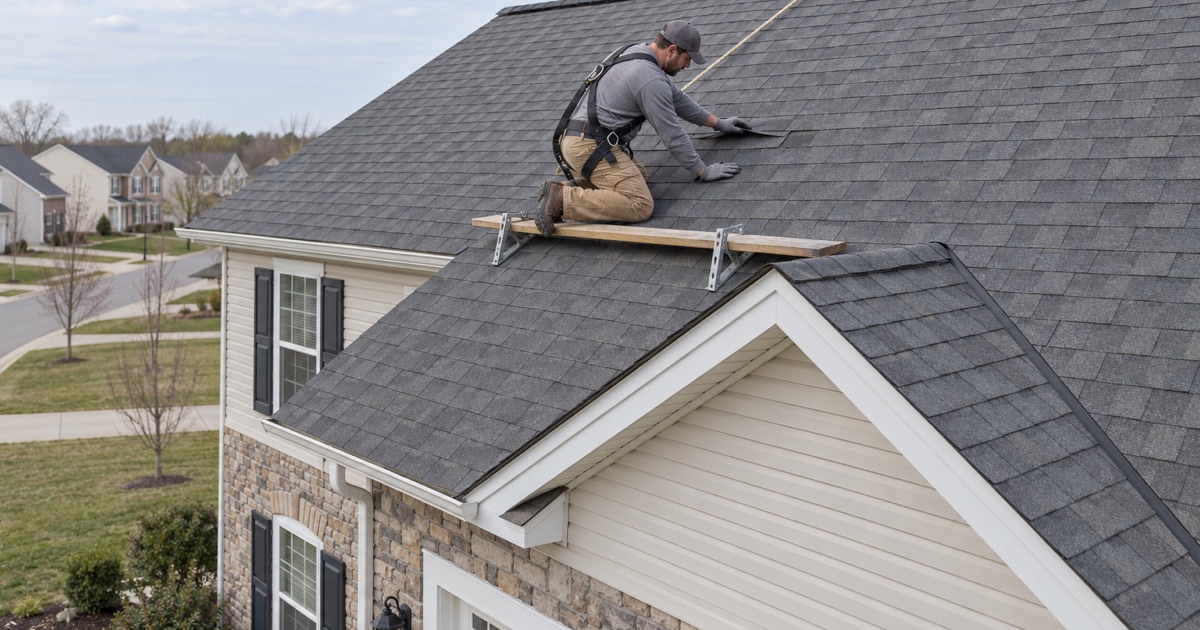
Woolwich is not finished building. The American Community Survey estimates that 202 of the township’s 4,401 housing units were built in 2020 or later, with another 1,093 dating from the 2010s, and those are survey estimates rather than a final tally. The population went from 3,032 in 2000 to 10,200 in 2010 and reached 12,577 at the 2020 census, its highest count ever.
Weatherby and the newest neighborhoods
Much of that growth sits in the Weatherby development. A township official told Business View in July 2022 that a lot of the homes built over the previous 20 years went up there, and put the eventual build-out at about 4,200 homes. Names around it include Four Seasons at Weatherby, built from 2005 through 2014, and The Reserve at Weatherby, a DeLuca Homes single-family community.
Construction has not stopped. Ryan Homes is marketing The Preserve at Weatherby, a gated community with house plans still listed for sale, so new roofs are still being framed and shingled in the township. For those owners, the first months of a roof’s life are governed by a specific set of state standards, not only by the shingle manufacturer’s paperwork.
Why a new roof is a different call
A leak on a 25-year-old roof is a maintenance and repair question. A leak on a roof installed last spring is something else, because the house came with a warranty that sets out what the builder has to correct. Treating it like an ordinary repair call can mean paying for work the regulations place with someone else.
It also changes what a homeowner should do first. Before booking any repair, it helps to find the warranty date on your closing paperwork, take photographs of the stain and the roof, and note what the weather was doing the day the water appeared. Those three things answer most of the early questions, whoever ends up making the correction.
Looking for roofing closer to Delran? See Roofing Services in Delran.
What New Jersey’s New Home Warranty Says About Roofs
New Jersey’s new home warranty rules sit in the state administrative code at N.J.A.C. 5:25. The Department of Community Affairs describes them as providing limited ten-year coverage against defects of materials, workmanship and systems in a new home. That ten-year figure tells only part of the story, and the roof falls mostly in the shortest tier.
The one-, two- and ten-year tiers
Under N.J.A.C. 5:25-3.2(a), a new home must be free of performance standard defects for one year from the warranty date. Mechanical and electrical system defects carry two years, and major structural defects carry ten. The roofing, flashing and gutter items are written as performance standards, so the year that matters for most roof complaints is the first one.
What the warranty date is for a particular house, whether coverage passes to a later buyer, and how a claim is filed are set out in the warranty documents and the rules themselves, and we do not guess at them. If you bought new in Woolwich, your own papers are the place to find your dates before calling anyone about a leak.
Roof and flashing leaks in the first year
The roofing standard in N.J.A.C. 5:25-3.5 is direct. A roof or flashing leak that occurs under normal weather conditions is a deficiency, and the builder is to correct any leak verified to have happened under those conditions. The working word is verified, which is why the cause of a leak has to be pinned down before anything else happens.
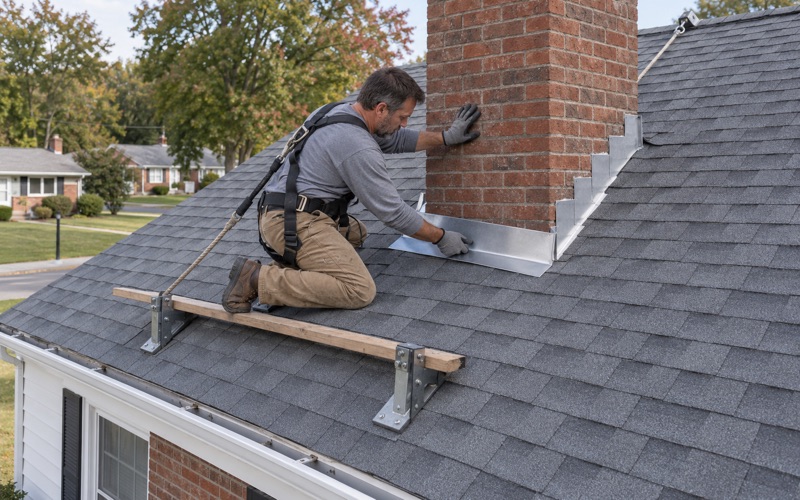
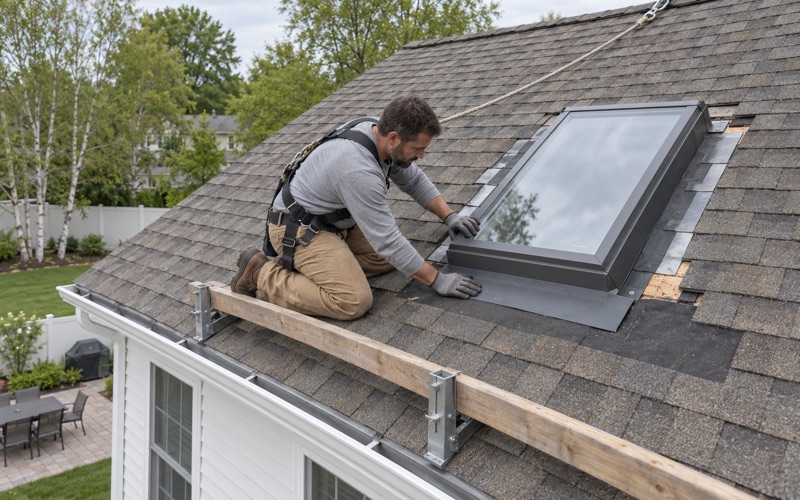
Flashing is where many of these leaks start on new construction. Step flashing along a sidewall, apron and kick-out flashing where a roof meets a wall, and the metal around chimneys, skylights and pipe boots all depend on careful installation. When water reaches a ceiling below one of those spots during an ordinary rain, the flashing is the first thing we examine.
Lifted, curled or torn shingles
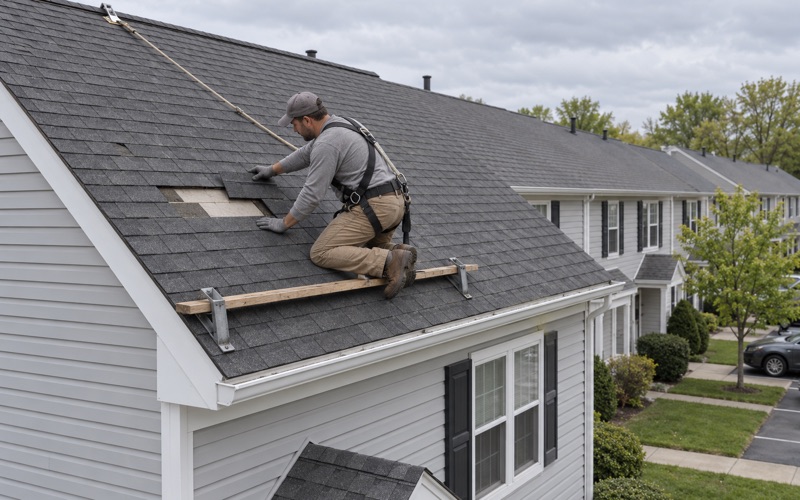
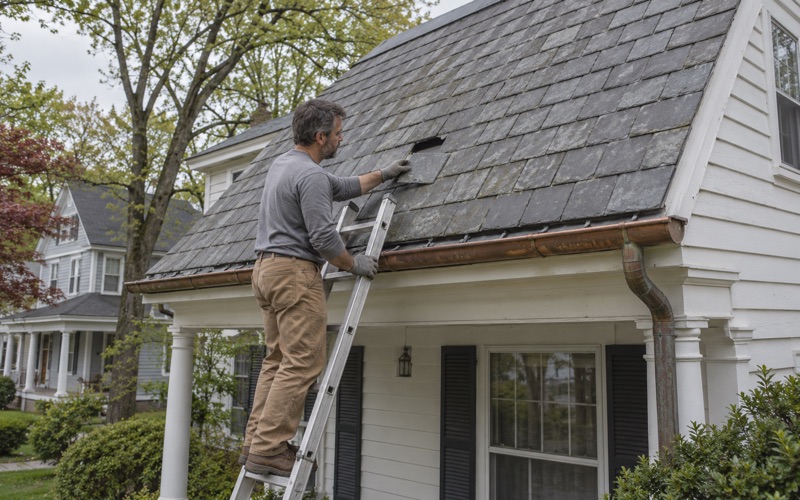
The same standards treat shingles separately. Shingles that lift or curl during the first year of warranty coverage are a deficiency, and so are shingles that tear loose in normal weather; the builder must repair or replace them. On a new roof, a row of tabs sitting up off the course below is worth photographing the day you notice it.
Gutters that leak or hold water
Sheet metal gutters and downspouts have their own standard. A leaking gutter, or one not pitched to drain, is a deficiency, though standing water up to one inch is acceptable. Keeping gutters clear of leaves and debris stays the owner’s job, so a gutter overflowing because it is packed with leaves is not the same complaint as one sloped the wrong way.
Storms, Ice and Wind Sit Outside the Roof Standard
The roof-leak standard carries an exclusion that changes everything about a first-year call. Leaks caused by severe weather, such as ice and snow build-up, high winds and driven rain, are excluded from it. A house only a few months old can still take water in a hard wind-driven storm, and that leak is not one the standard places with the builder.
Establishing whether weather caused it
That makes the first question on a new Woolwich house easy to ask and harder to answer: did weather cause this? We look at when the leak appeared, what the weather was doing, and what the roof and attic show. Creased or missing shingles across one face of the roof tell a different story than a single wet stain beneath a sidewall.
Woolwich sits in National Weather Service forecast zone NJZ017, Gloucester, served by the Mount Holly office, and the forecasts and warnings issued for that zone are a useful record of what a given day brought. They are a forecast record rather than a measured history of your street, so we treat them as one piece of evidence alongside the roof itself.
When the damage is from a storm
If the evidence points to a storm, the leak becomes an insurance question rather than a warranty one. We photograph the damage and write it up for your own homeowners claim, and when you ask, our crew will meet the adjuster at the house. The claim itself stays yours; we supply the documentation and the repair scope.
Some first-year leaks are mixed. A small flashing gap may have let water in only once wind drove rain sideways against the wall, which leaves a fair question about whether the weather or the installation was the real cause. We describe what we found without deciding the warranty question for you, since that judgment belongs to the warranty process, not to a roofer.
Ice build-up deserves a word because it is named in the exclusion. Water backing up behind ice at the eaves can reach the decking even on a sound new roof, and a self-adhering ice and water barrier meeting ASTM D1970 along the eaves is the usual defense. Whether one was installed is often visible only once edge shingles are lifted, so we say so rather than assume.
After the First Year: Leaks on a Newer Woolwich House
Once the first year has passed, a leak on a five- or eight-year-old house is usually a repair question for the owner rather than a performance-standard complaint. That does not make it a replacement job. On a roof this young, the honest answer is usually a targeted repair, and we tell you whether the roof can be fixed before replacement is ever mentioned.
Tracing the water on a young roof
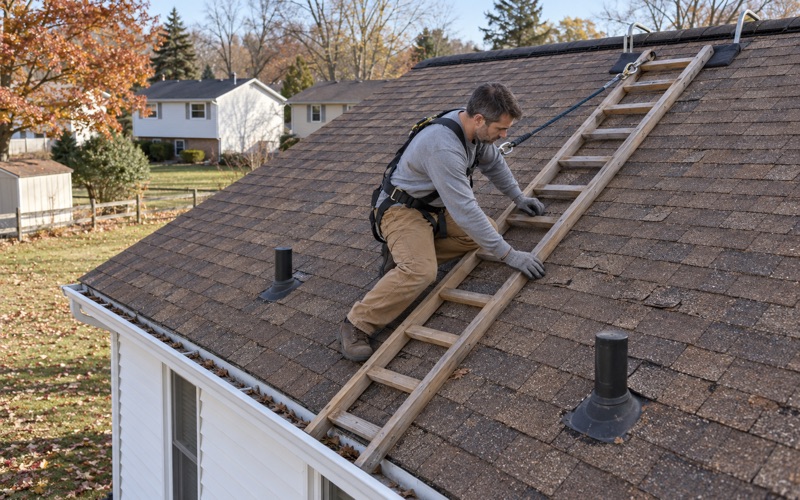
Newer roofs tend to leak at details rather than across the open field of shingles. A pipe boot whose rubber has split, a kick-out flashing missing at the bottom of a sidewall, or a ridge vent letting in driven rain are typical. Tracing the stain from the ceiling back through the attic to the roof deck usually narrows it to one spot.
When the source is a flashing detail, we replace the flashing rather than smear caulk over the joint. Sealant buys a season at best, while new step flashing or a properly lapped apron closes the path the water was taking. The estimate lists that flashing as its own line, apart from shingles and any decking, so you can see exactly what the repair consists of.
Gutters, ventilation and the details that age first
Gutters on the township’s newer streets deserve a look whenever a leak shows up near an eave. A gutter that has lost its pitch can hold water against the fascia and drip edge, and downspouts emptying beside the foundation create a different problem below. We check both, and seamless aluminum replacements are priced as a separate line on the estimate.
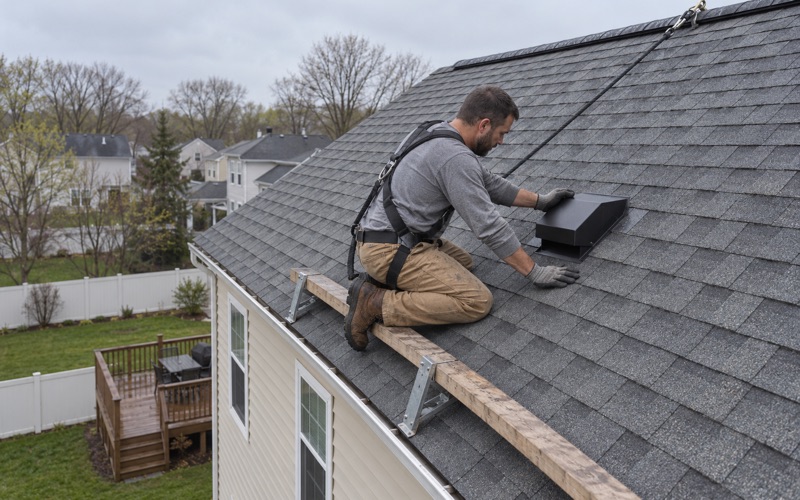
Attic ventilation also shows up early on new houses. A ridge vent needs matching soffit intake to move air, and when insulation blocks the soffits, the attic runs hot in summer and damp in winter. Condensation dripping from nail tips can look exactly like a roof leak, which is one more reason every call we take starts in the attic.
Repairs, contracts and the work day
If a repair is the right call, the written estimate says so plainly, and the contract follows New Jersey’s home improvement rules, including the notice of your right to cancel. If it is not, because the deck or the shingles have a wider problem, we explain why before a replacement figure appears on paper.
Work in a newer neighborhood usually happens with neighbors close by and lawns still filling in. At the end of each work day our crew cleans the yard, driveway and gutters and runs a magnet sweep for nails. When replacement shingles are needed, we hold samples against the siding or brick on your house so the repaired section does not stand out.
- 20+ Years in Business
- Line-Item Written Estimates
- NJ and PA Contracts