Gloucester Township Roofing brings more than 20 years of work to roofing in Upper Providence Township, and on the oldest houses here the first conversation is rarely about shingle color. It is about what is already on the roof, what shape it is in, and whether it should stay, be mended or come off. We help owners answer that question with the facts laid out in front of them.
Our visit starts in two places, the attic and the roof surface, because a stain on a plaster ceiling often sits several feet from where water actually gets in. Once the entry point is found, you get a direct answer on whether a repair will hold before anyone mentions replacement. Plenty of old roofs need a careful fix rather than a new roof.
When replacement is the right call, the written estimate lists tear-off, decking, underlayment, flashing, ventilation and gutters on separate lines. That lets you set our number beside another roofer’s and compare each item instead of two totals. The sections below cover the questions that come up most often on older houses in this township.
Upper Providence’s Old Houses and Who Decides Their Roofs
Country houses from before the Revolution
The township’s 2005 comprehensive plan records that Upper Providence was a popular place for country homes owned by wealthy Philadelphians even before the Revolution. It also notes that a number of private homes from the eighteenth and nineteenth centuries are still in use, though the acreage that once surrounded most of them is long gone. Many are listed and pictured in the Tricentennial Commission’s 1999 book, A Land of Providence and Its People.
Census figures give a sense of scale. Of 4,288 housing units counted in the 2024 five-year American Community Survey, 362 were built in 1939 or earlier. That is a small share of the township, but each of those houses carries a roof history that a younger home does not, and the person who owns it is usually the one left to sort that history out.
No historic board in the plan, so the owner makes the call
The same 2005 plan states that without a standing historic commission or committee of some kind, there is no one with official standing to act as an advocate for historic resources at the township level. It set objectives for a roster of historic sites and an Upper Providence Treasures plaque program. We have not found a record of whether a commission was created after 2005, so it is worth asking the township rather than assuming either way.
What the plan describes, in practice, is that choices about an old house’s roof rest with its owner. As of that plan, no board was reviewing whether a replacement matched what came before. That freedom cuts both ways: nobody blocks a poor decision, and nobody makes the careful one for you. We try to lay out the options plainly enough that the decision is genuinely yours.
The permit still applies
Owning the decision does not mean skipping the paperwork. The township’s Permits and Applications page lists a roofing permit among the permits required prior to starting any project, and inspections are scheduled through Linn Architects. The application describes itself as being for UCC compliance only, which means it checks the work against the building code, not against the house’s age, its history or its original materials.
Looking for roofing closer to Upper Chichester? See Roofing in Upper Chichester.
Keep, Repair or Remove the Old Covering
The one line the permit form draws
The township’s roofing permit application lets an existing covering stay under a new roof only when there are fewer than two layers, the covering is in good condition, and it is not slate, clay or cement tile. Put plainly, a new roof cannot be laid over slate or tile, and it cannot become a third layer. That rule is the one fixed point in an otherwise open decision.
Deciding what the old roof needs
On an eighteenth- or nineteenth-century house, the first question is what the existing covering is and whether it still does its job. A sound roof with a few failing spots is a repair. A covering worn out from eave to ridge is a replacement. The hard cases sit in between, and those are where an honest look at the attic and the deck earns its time.
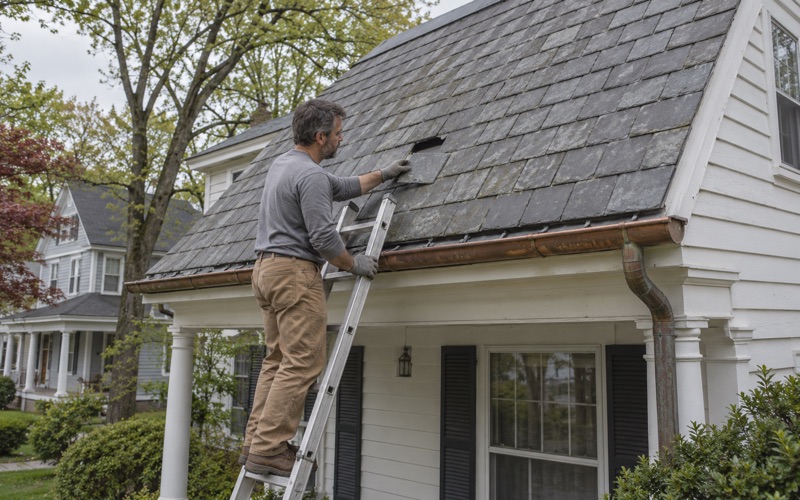
If the covering turns out to be slate, the permit rule settles one thing: it either stays and is maintained, or it comes off completely before anything new goes down. Where slate or cedar is being kept, we repair it with matching material when that material can be found, not with whatever happens to be on the truck. When a match cannot be found, we tell you so before any work begins.
What a tear-off can reveal
Old houses often hide their condition under the roofing. When the shingles come off and decking turns out to be rotted, we photograph it and show it to you before replacing anything, and the per-sheet price for that work is fixed in the contract ahead of time. You see the damage with your own eyes, and you already know what it costs.
That matters more on an old house than on a new one, because nobody can promise what lies under a roof that may have been redone several times. A fixed sheet price keeps a surprise from turning into an open-ended bill. The photos also give you a lasting record of what was actually there, which is useful if you ever sell the house or document its history.
Old Roofs on Houses Enlarged Over the Years
Where additions meet the original roof
Many old houses were enlarged over time, though that is a general pattern and not a recorded fact about any particular home in the township. Where it happened, the joint between an addition and the original roof is often the weak point: two roof planes, built decades apart, meeting at a valley or a sidewall. Water finds those seams long before it works through the open field of the roof.
When we trace a leak on a house like that, the attic usually tells us whether the water is coming through the old section, the newer one, or the line between them. That distinction decides whether the fix is a few feet of flashing or something larger. It also keeps us from pricing a whole replacement for a problem that lives in a single seam.
Flashing replaced, not caulked over
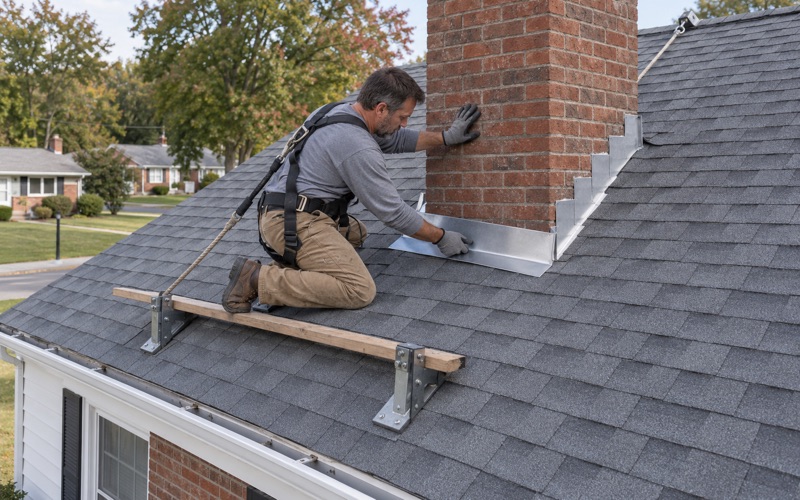
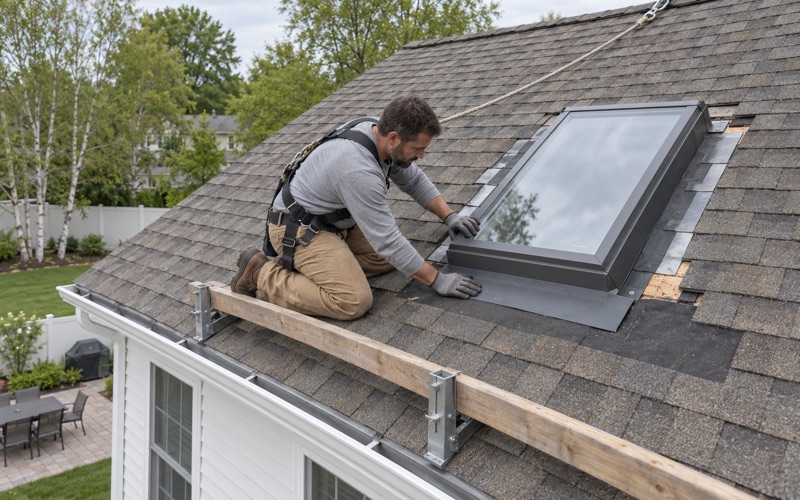
When the roof on an enlarged house is redone, we replace the flashing at chimneys, sidewalls, skylights and valleys rather than sealing the old metal with caulk. Caulk buys a season or two at most. New step flashing and counterflashing along a sidewall, a cricket behind a wide chimney, and properly lapped valley metal are what keep those seams dry for the life of the new roof.
Ventilation deserves the same attention. Additions often changed how air moves through an attic, and an old house may have little intake at the eaves at all. The township’s permit form sets ventilation at 1 to 150, and we plan ridge vent and soffit intake to meet that figure rather than adding vents wherever they happen to fit.
Matching a new section to an old house
Sometimes only the addition’s roof needs replacing while the main roof still has years left. In that case color matters, because the new section sits right beside stone, brick or old siding that cannot be changed. We bring samples to the house and hold them up against the actual walls, since a shingle that looks right in a brochure can look wrong next to weathered stone.
Keeping an Old Roof Sound Between Replacements
Small repairs that protect the house
A roof that does not need replacing still needs looking after. On an old house, a slipped slate, a cracked pipe boot or a lifted piece of flashing can let water into the framing for months before a stain shows on a ceiling. Catching those early costs far less than any replacement and keeps more of the existing roof in place for longer.
Our repair visits follow the same order as a leak call: attic first, then roof. If the problem is limited, we fix it and say so plainly. If we see something that will need attention in a few years, we tell you that as well, so you can budget for it on your own schedule rather than discover it the hard way.
Ice barrier, low slopes and the record of the work
When a new roof does go on, the township’s permit application requires ice barrier from the eave to 2 feet inside the exterior wall line, with photographs taken during installation. We take those pictures as a matter of course and share them with you, so the record of what sits under your shingles never depends on anyone’s memory.
On slopes of 4:12 or less, the same application calls for double underlayment. An old house and its additions can combine a low-pitched porch or shed roof with steeper main slopes. We detail each surface by its own pitch rather than treating the whole roof as one plane, which is where low sections on mixed roofs tend to go wrong.
Working on a quiet residential street
Upper Providence is overwhelmingly residential, and most of Ridley Creek State Park lies inside the township toward its northern edge. On a quiet street near Media or off Providence Road, a roofing crew gets noticed. We clean the yard, driveway and gutters at the end of every work day and run a magnet sweep for roofing nails.
If the house carries solar panels, their removal and reinstallation are planned into the schedule before work starts, not sorted out the morning the crew arrives. Decisions about an old Upper Providence roof belong to the people who own it. Our part is to make sure those decisions are made with the attic, the deck and the permit rule all in plain view.
- 20+ Years in Business
- Line-Item Written Estimates
- NJ and PA Contracts