Gloucester Township Roofing has handled roofing in Mantua for more than 20 years, and the first question most owners ask us is whether the roof needs replacing at all. We answer that plainly, and a repair is always weighed before any replacement figure goes on paper. When the call is about a leak, we go into the attic as well as onto the roof, so the water is traced to where it actually gets in before we price anything.
This page is about one thing that shapes how a roof should be built on certain Mantua lots: the open land beside the house. Wind behaves differently when nothing taller than a fence stands between a field and the back of a home, and the eaves, rakes and ridge are where that shows first. We look at what surrounds a house before we recommend a shingle, an underlayment or a nailing pattern.
Our written estimates set tear-off, decking, underlayment, flashing, ventilation and gutters on separate lines. That lets you lay our number beside another contractor’s and see exactly where the two differ, rather than weighing one lump total against another. If a competing bid leaves out edge metal or a ridge detail, a line-by-line sheet makes the gap easy to spot.
How Much of Mantua Is Meant to Stay Open
Mantua Township in Gloucester County covers 16.00 square miles of land, and the township has made a deliberate habit of keeping part of it undeveloped. By its own count, it has preserved 24 farms totaling 1,089.67 acres and 12 open-space parcels totaling 696 acres. For a homeowner, the point is simple: some of the ground next to houses here is meant to stay open for good.
A preservation record that started in 1999
The township says the first farm it preserved was the Eachus Farm, back in 1999. Mayor Robert Zimmerman wrote in July 2024 that Mantua had secured 696 acres of open space. Those totals are the township’s own statements rather than a state tally, and the two lists may overlap, so we read them as a direction of travel rather than an exact share of the map.
That direction is still adding ground. Gloucester County’s farmland preservation plan update, adopted January 14, 2025, includes a new Mantua project covering five farm parcels adjacent to James Atkinson Memorial Park. Each parcel that enters the program is ground expected to stay in fields rather than fill in with rooftops.
Houses at the edge of a field or park
Most Mantua homes sit among other homes and trees, which break up the wind long before it reaches a roof. Some lots are different. Their back line meets a field, a park or a long run of open ground, and on those lots there can be very little upwind that is taller than a hedge.
Nobody can tell from a map alone which particular houses back onto preserved parcels, and we do not guess. What we can do is stand in your yard and look at what the wind crosses before it reaches your roof. That walk around the house is part of every estimate we write on a lot with an open edge.
Looking for roofing closer to Haddon? See Haddon Roofing.
Why Open Ground Upwind Changes the Wind on a Roof
The residential building code does not size wind loads on wind speed alone. It also asks what the terrain upwind of a house looks like, because rough ground slows the wind near the surface and smooth ground lets it arrive with less to stop it. The load on a roof covering further depends on the roof’s mean height, its pitch, the size of the area in question and where on the roof that area sits.
Exposure B and Exposure C in plain terms
In the code’s language, surface roughness B covers urban and suburban areas, wooded areas and ground with many closely spaced obstructions the size of a single-family house or larger. Exposure B applies when that kind of terrain extends upwind for at least 1,500 feet, for roofs up to 30 feet high. Roughness C is open terrain with scattered obstructions generally under 30 feet tall, which takes in flat open country and grasslands, and Exposure C applies where B and D do not.
The gap between the two is not small. Connecticut’s training material on the 2015 International Residential Code states that, for a 30-foot mean roof height, Exposure C loads are 40 percent higher than Exposure B loads, and its table lists an Exposure C factor of 1.21 at 15 feet. Those are code-training figures for those heights, not a measurement taken on any house in Mantua.
Exposure belongs to one house, not a neighborhood
Exposure is decided by the ground upwind of a specific house, which is why we never attach a category to a street or a corner of the township. A home at the edge of a field may face open land on one side and a row of neighbors on another, and wind arrives from more than one direction over the course of a year. Whether a given roof was designed for open terrain is a question for that property’s own records.
Preserved land adds one more consideration. A protected field is likely to keep that upwind side open for the life of the next roof, while an ordinary vacant lot could be built on within a few years. That is our reasoning from the preservation record, not a code ruling, but it is a fair reason to plan a field-facing roof as an exposed one.
Edges, Ridges and Fastening on an Exposed Roof
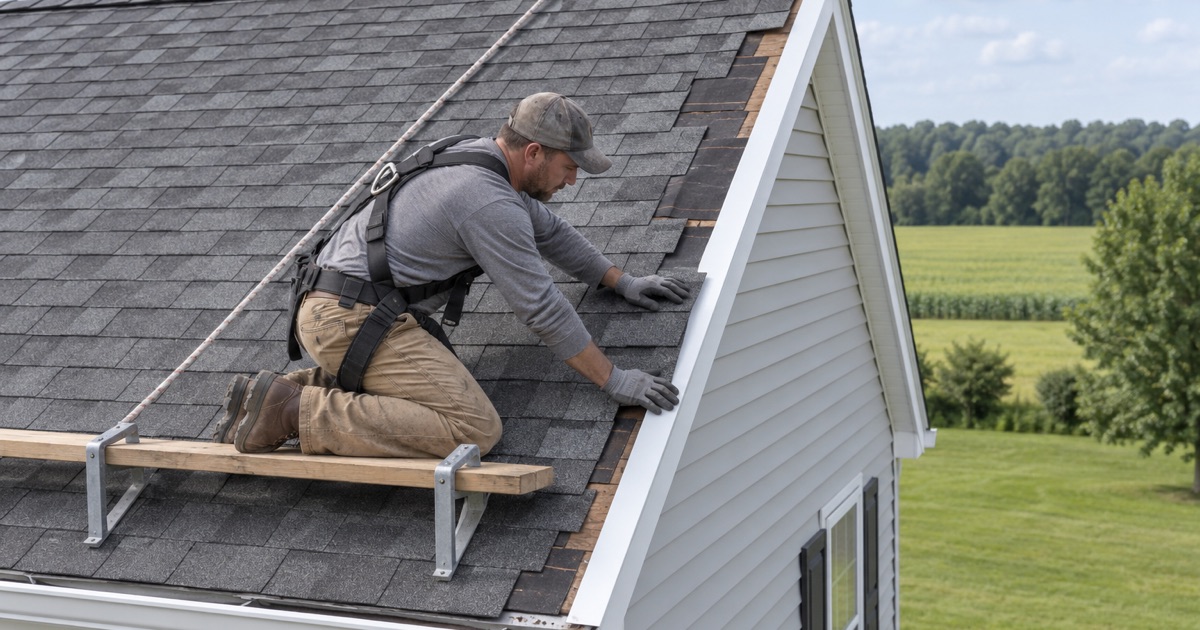
Wind does not pull evenly across a roof. Uplift concentrates at the eaves, the rakes, the corners and the ridge, where air separates from the surface, so those are the places an exposed roof tends to lose shingles first. On a lot with open ground upwind, most of our detail work goes into those lines.
Drip edge, starter and the rake line
Drip edge at the eaves and rakes gives the first course of shingles a straight, solid edge to seal against. Above it, a starter strip with its own adhesive line holds down the bottom of the first visible course. On a slope that faces a field, we check that both are fastened at the spacing the manufacturer calls for rather than stretched out to save time.
Rakes deserve the same attention. A gable end turned toward open ground catches wind sideways along its edge, and a loose rake shingle is often where a peel begins. We fasten and seal the rake line so the shingle edge stays tight to the metal beneath it.
Nailing pattern and the sealant strip
A shingle’s wind rating assumes it was nailed where the manufacturer specifies, with the right number of nails, and that its sealant strip bonded to the course below. Nails set above the line or driven at an angle can leave a shingle hanging on adhesive alone. On an exposed roof we use the manufacturer’s high-wind nailing pattern where one is offered and watch the nail line on every course.
Sealant strips bond with warmth and sun after installation. A roof put on late in the fall may not seal fully until warmer weather returns, so on a field-facing slope we hand-seal shingles along the most exposed edges when the season calls for it.
Ridge caps, underlayment and flashing
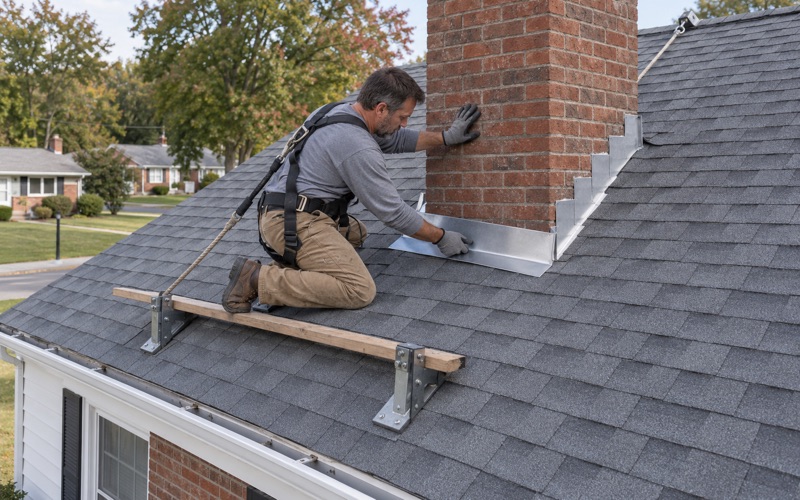
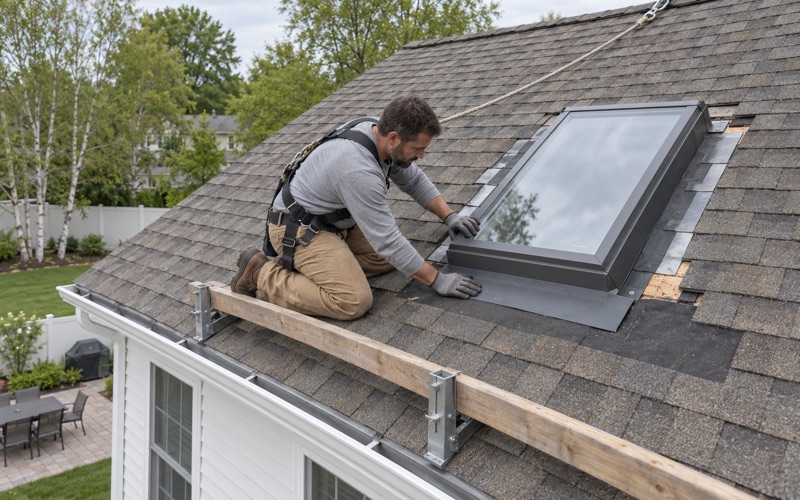
The ridge is the highest and most exposed line on the house. We use cap shingles made for the ridge, fasten them with nails long enough to bite solidly into the deck, and balance a ridge vent with enough soffit intake to match its net free area. Flashing at chimneys, sidewalls, skylights and valleys is replaced with the roof, never sealed over with caulk.
Underneath, an ASTM D1970 self-adhering ice and water barrier at the eaves and an ASTM D8257 synthetic underlayment across the field give the roof a second line of defense if a tab ever lifts. When the old shingles come off and rotted decking turns up, we photograph it and show you before it is replaced, at the per-sheet price written into the contract.
Choosing a Shingle Wind Rating for an Open-Field Lot
Shingle packaging carries wind ratings from two different tests. ASTM D3161 is a fan-driven test, and Class F is its highest class. ASTM D7158 measures uplift resistance, and Class H is its top class. Many architectural (laminated) shingles carry both, and lines such as GAF Timberline HDZ, Owens Corning Duration and CertainTeed Landmark publish their ratings along with the installation conditions that go with them.
What a rating covers and what it does not
A wind rating describes how a shingle performed under test conditions when installed exactly as specified. It is not a promise about a particular storm, and it cannot make up for a short nailing pattern or a missing starter course. That is why we settle the installation details first and the product second.
We do not tell any Mantua owner that a house must carry a particular rating. For a lot facing open ground, we lay out the choices, explain how the higher classes differ, and show the price difference on its own line of the estimate so the decision stays with you.
Color chosen against the house itself
A strong wind rating and a good-looking roof do not have to compete. We bring shingle samples to the property and hold them up against the actual brick, stone or siding, because a color that looks right in a brochure can read quite differently on a house that sits in full sun beside open land.
When wind does get under the shingles
If a blow does lift shingles, we photograph the damage and write it up for your own insurance claim, and we will meet the adjuster at the house when you ask. Our contracts follow New Jersey’s home improvement rules, including the notice of your right to cancel.
The job site gets the same care as the roof. At the end of every work day we clean the yard, the driveway and the gutters, then run a magnet across the ground for stray roofing nails, which matters on a lot where children, pets or a mower will be crossing the grass the next morning.
- 20+ Years in Business
- Line-Item Written Estimates
- NJ and PA Contracts