Gloucester Township Roofing brings more than 20 years of roofing work to Harrison Township, and much of what we plan here is a first replacement: the original roof coming off a house for the first time since it was built. That job deserves more care than a routine re-roof, because tearing off the builder’s shingles is the first time anyone sees the deck edge, the fascia and whatever metal sits along the eaves.
We start every conversation with a straight answer on whether the existing roof can be repaired instead of replaced. If a leak brought you to us, we check the attic as well as the shingles, so the water is traced to where it actually gets in before a single number goes on paper. Sometimes that answer buys a roof several more years.
When replacement is the right call, our written estimate lists tear-off, decking, underlayment, flashing, ventilation and gutters as separate lines. That lets you set our bid beside anyone else’s and compare the same work item by item, including the detail that matters most on houses of this age: how the roof edge will be finished.
Harrison Township’s Subdivisions and the Code They Were Built Under
Two decades of building
Harrison Township grew fast around the turn of the century. The 2000 census counted 8,788 residents, and by 2020 the township had 13,641. Census housing estimates show where that growth landed: 1,146 homes built in the 1990s and 1,279 in the 2000s, together 2,425 of the township’s 4,465 housing units, or 54.3 percent.
Much of that construction took the form of acre-lot subdivisions around Mullica Hill. Turtle Creek Estates is typical, with two-story Colonials on one-acre parcels, and a 1998 house on Winding Way and a 2003 house on Belmont Court both sit on lots of more than 1.1 acres. Harrison Estates, off Fawn Hollow Lane, is another of the township’s subdivisions.
What New Jersey’s residential code said
Every one of those houses was built under a version of New Jersey’s residential code that did not ask for drip edge. The state’s one- and two-family dwelling subcode followed the CABO model code through its 1995 edition, then moved to the International Residential Code in its 2000, 2006 and 2009 editions.
The requirement for drip edge at the eaves and gables of shingle roofs entered the model code with the 2012 IRC, section R905.2.8.5. New Jersey never adopted that edition. The state went from IRC 2009 to IRC 2015, effective September 21, 2015, by which point the township’s 1990s and 2000s housing had long been finished.
Not required is not the same as missing
That code history tells us what was not required, not what crews actually installed. Builders often put drip edge on anyway, and nothing in the public record says which Harrison houses have it. The only way to know for a particular roof is to look at the eaves and rakes, and the clearest look comes at tear-off.
Home Innovation Research Labs, studying what the 2012 code changes would add to construction cost, priced the drip edge requirement at $226 to $381 for its reference house, depending on location. It is a modest line item at new construction, which is one reason it is worth deciding deliberately at replacement rather than leaving it to habit.
Looking for roofing closer to East Greenwich? See Roofing in East Greenwich.
What the Roof Edge Shows at the First Tear-Off
Eaves and rakes once the shingles come off
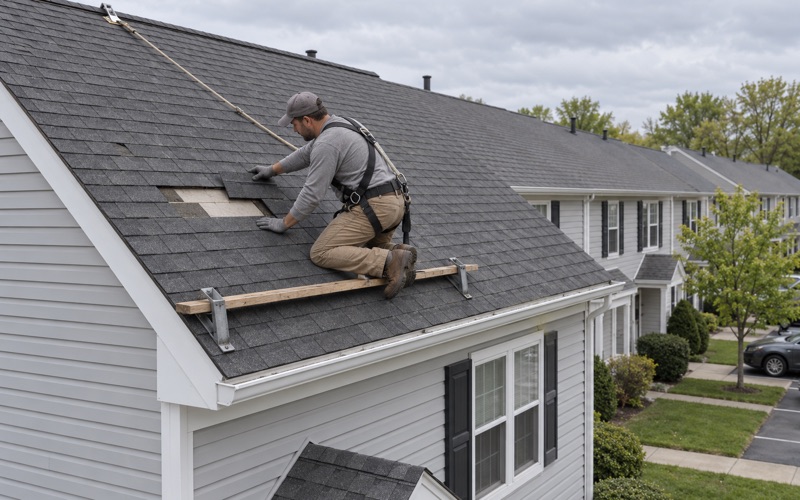
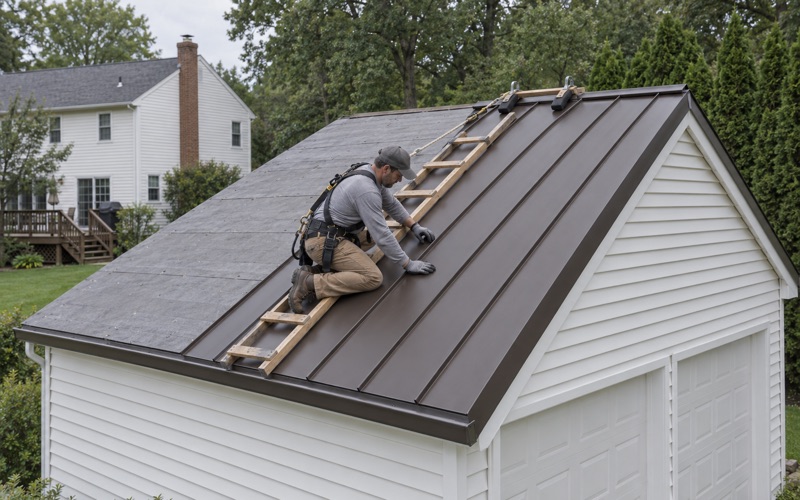
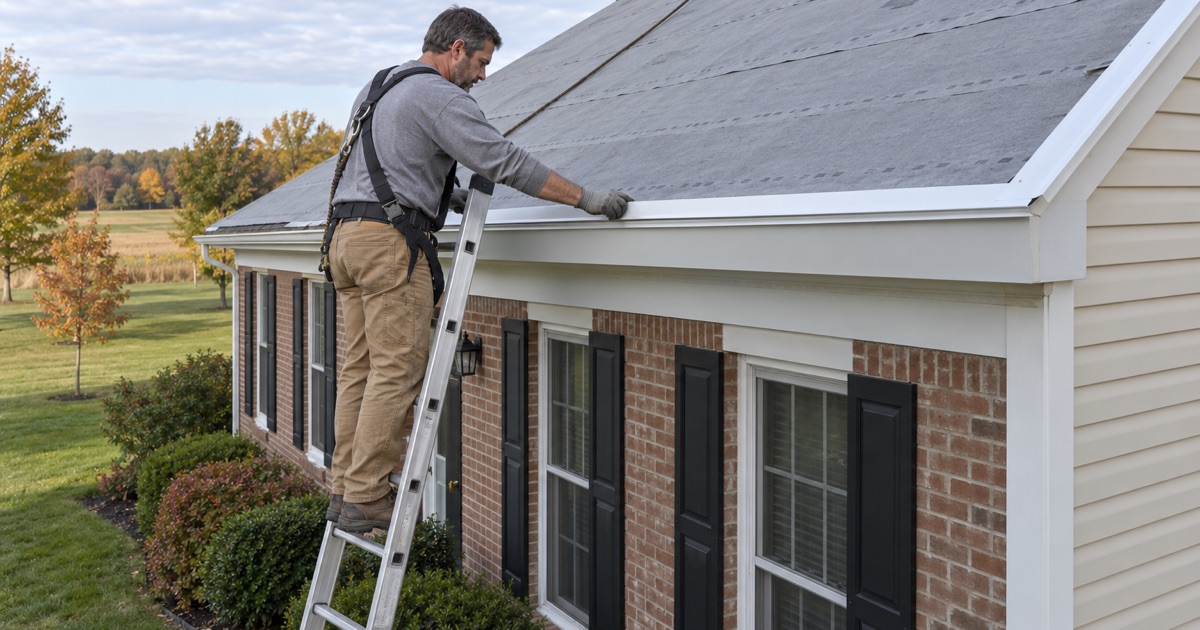
On a first replacement, the starter course and the lowest rows of shingles come off and leave the edge exposed. We look at whether metal is already there, how it laps the fascia, and whether the original underlayment was run over or under it. On the rakes, the sloped gable ends, we check the same things along the whole run.
Where drip edge is present and sound, we tell you, and the estimate says whether it is being kept or replaced. Where there is none, we show you the bare edge and explain the options. Either way the roof edge gets its own line in writing rather than being folded quietly into a total.
The deck edge
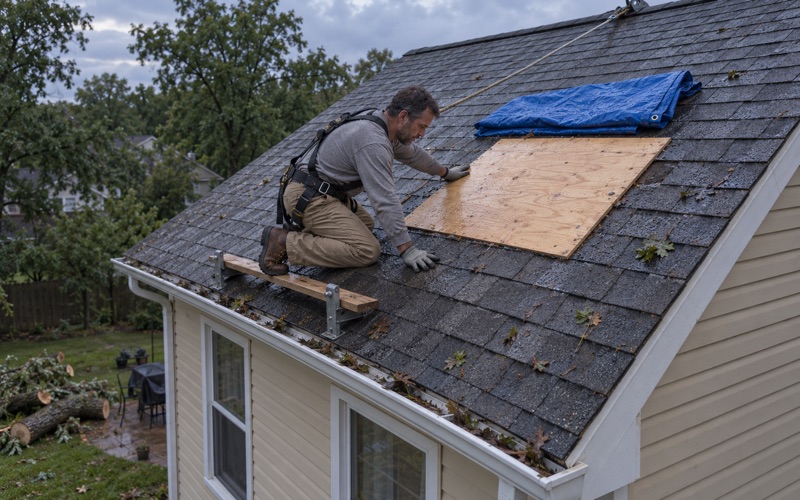
The outer few inches of roof sheathing are where wind-driven rain and ice dams tend to find their way in on an edge with no metal. Once the shingles are off, soft or delaminated sheathing along the eaves is easy to see, and it is commonly among the first decking on an older roof to need attention.
Any rotted decking we find is photographed and shown to you before it is replaced. The per-sheet price is fixed in the contract before work starts, so a few soft panels along the eaves never turn into an open-ended charge, and you see exactly which sheets were changed and why.
Starter strip and the first course
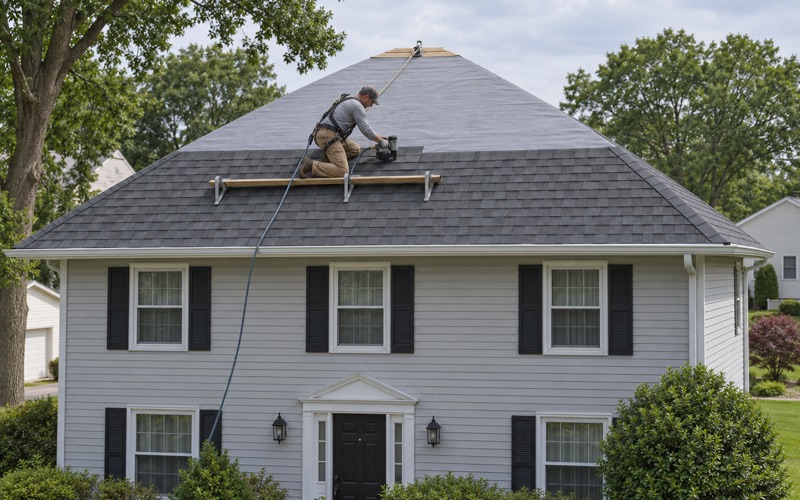
The edge is also where a new roof’s wind performance begins. On a two-story Colonial the eaves are high and exposed, and we set the starter strip and first course so the sealant strip bonds tightly along the edge. Architectural shingles rated to ASTM D3161 Class F or ASTM D7158 Class H are common choices for that reason.
Fascia, Gutters and Flashing on an Acre-Lot Colonial
Fascia behind the gutter
Fascia boards on 1990s and 2000s Colonials sit behind the gutters, where they are hard to inspect from the ground. When the edge is opened during a first replacement, we check the board for soft spots, stains and loose fasteners, particularly at inside corners and where downspouts collect water from long runs of roof.
If a fascia board is damaged, we point it out with photos and price the repair separately, so you can decide whether to handle it now or schedule it later. Replacing a short run of fascia while the edge is already open is far simpler than coming back after the new shingles and edge metal are in place.
Gutters and the drip edge together
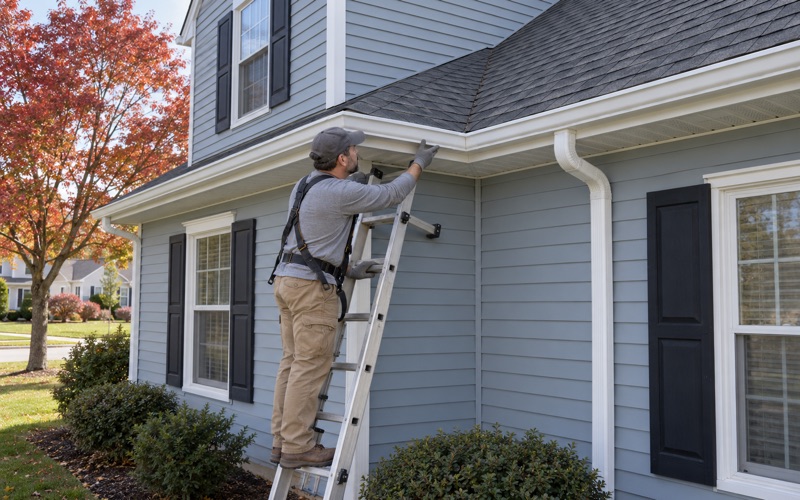
Drip edge and gutters work as a pair. The metal edge is meant to carry water past the fascia and into the gutter, rather than letting it run down behind the trough. On a first replacement we check how the existing gutters hang relative to the new edge, because a gutter set too low or too far out defeats the purpose.
On a house with long eave runs, the gutter line can be a substantial piece of the job. If the old gutters are sound, we work around them; if they sag, leak at the seams or are pitched wrong, seamless aluminum gutters and downspouts appear as their own line on the estimate. Either way you see the decision, not just a number.
Flashing at walls, chimneys and valleys
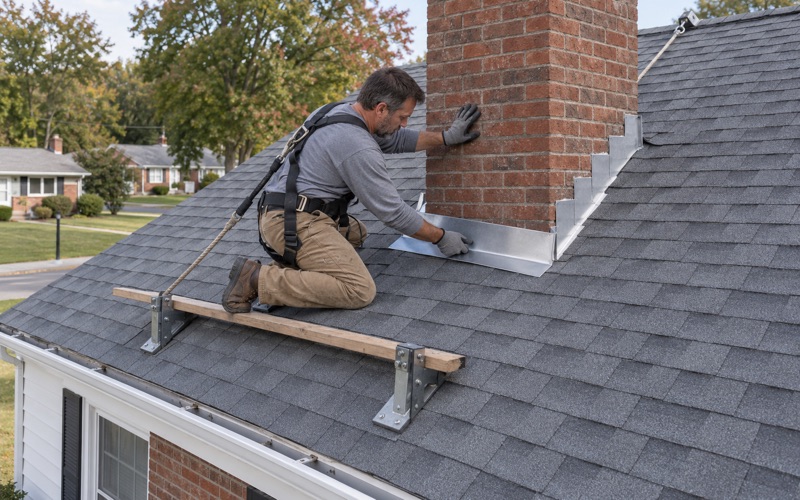
The first replacement is also the first chance to renew flashing that has been in place since construction. Step flashing along sidewalls, apron flashing at the base of a wall, and kick-out flashing where a roof edge ends against siding are all replaced with the roof. We never seal old flashing over with caulk and call it finished.
Chimneys and valleys get the same treatment. A chimney is reflashed with step flashing and counterflashing, and a wide chimney on the uphill side of a roof may call for a cricket to split the water around it. Valleys are rebuilt with an ASTM D1970 self-adhering ice and water barrier beneath the new shingles.
Planning the First Replacement on a Mullica Hill House
Confirming what is on the house now
Not every house in a subdivision is still on its original roof. A 1997 Colonial in Turtle Creek Estates was recently listed with an architectural shingle roof described as newer, so neighbors on the same street can be at very different points. We start by confirming what is actually on your house before suggesting anything.
Signs that a first replacement is getting close include granules collecting in the gutters, shingles lifting or creasing after wind, and stains on the attic sheathing. None of those settles the question on its own. We inspect from the attic and from the roof, then give you a plain verdict on repair versus replacement.
Weather and scheduling
Harrison Township sits in the National Weather Service’s Gloucester forecast zone, NJZ017, covered by the Mount Holly office. We watch that forecast when we schedule a tear-off, because an open deck edge needs dry hours, and we plan the day so the eaves and rakes are covered before the crew leaves.
At the end of each workday we clean the yard, the driveway and the gutters and run a magnet sweep for nails. On an acre lot that sweep covers more ground than it would on a small parcel, and we treat the lawn, beds and driveway as part of the job rather than an afterthought.
Choosing the shingle and signing the contract
Color choices on these Colonials are made against the siding, brick or stone on the actual house. We hold samples up on site rather than picking from a brochure, since a shade that looks right indoors can read very differently against siding in full sun. GAF Timberline HDZ, Owens Corning Duration and CertainTeed Landmark are typical lines to compare.
Our contract follows New Jersey’s home improvement rules, including the right-to-cancel notice. It puts the drip edge decision, the per-sheet decking price and the flashing work in writing, so the first replacement on your Harrison Township house settles the roof edge on purpose instead of by default.
- 20+ Years in Business
- Line-Item Written Estimates
- NJ and PA Contracts