Gloucester Township Roofing has spent more than 20 years on roofing in Haddon, and on the houses here one feature decides more roof jobs than any shingle choice: the chimney. Where a brick stack rises through the roof, the joint between masonry and shingles is a seam the roof has to keep closed for decades, through every freeze, thaw and summer storm.
That is why a leak call here rarely stops at the shingles. We go into the attic as well as onto the roof, because water that slips past chimney flashing can run along a rafter or down the brick and show up a room away from where it got in. Finding the real entry point comes first, and the price comes after.
You will also hear a straight answer on whether the roof can be repaired before anyone mentions replacing it. Plenty of chimney leaks are a flashing problem on an otherwise sound roof, and fixing that one detail properly is often the right job.
Haddon Township’s Older Houses and the Heat Inside Them
A housing stock built mostly before 1960
Haddon Township is a place of established houses. Census figures from the 2024 five-year American Community Survey count 7,407 housing units, and 4,644 of them, or 62.7%, were built before 1960. Of those, 1,850 date from 1939 or earlier, 1,016 from the 1940s and 1,778 from the 1950s.
Those numbers are not a tour of house styles. They matter for one reason: houses of that age were built around a furnace or boiler that burned fuel, and the usual way to carry its exhaust out was a masonry chimney running up through the house and out the roof.
Gas and oil heat, and a chimney still doing its job
The same survey asks how occupied homes are heated. In Haddon Township, 5,318 of 6,989 occupied homes use utility gas and another 335 use fuel oil or kerosene, against 1,169 on electricity. Those are counts of households, not chimneys, and no one has surveyed how many houses here vent through brick.
Still, a gas or oil appliance has to vent somewhere, and in an older house that is commonly a masonry flue. A chimney that carries warm exhaust all winter is a working part of the house, not an ornament, so it deserves the same attention as the shingles around it when a roof is repaired or replaced.
What that means in Westmont, Oakdale and Crystal Lake
Whether the house sits near the downtown in Westmont or on a side street in Oakdale, Cuthbert or Crystal Lake, we treat the chimney as part of the roof system. We look at the flashing, the crown and the mortar on every visit, and we note what we see.
What we do not do is chimney sweeping, flue inspection or relining. If the inside of a flue looks like it needs attention, we say so plainly and suggest you have a chimney specialist check it before or alongside the roof work.
Looking for roofing closer to Gloucester City? See Roofing in Gloucester City.
Flashing Where Brick Meets Shingles
Step flashing along the sides
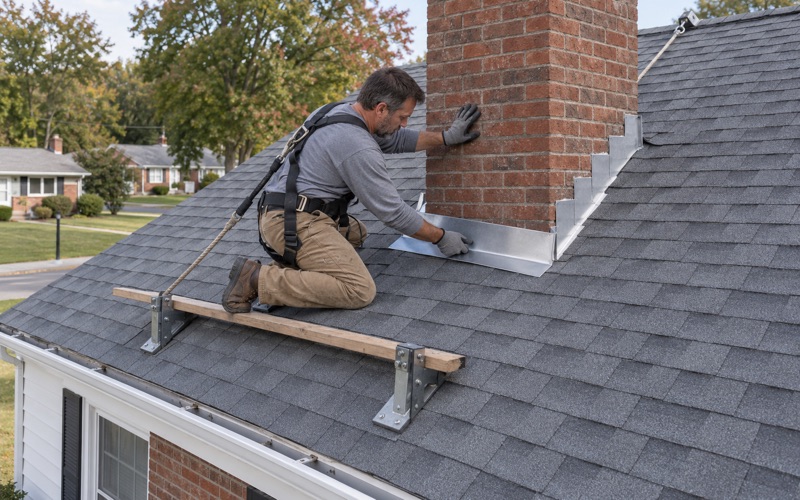
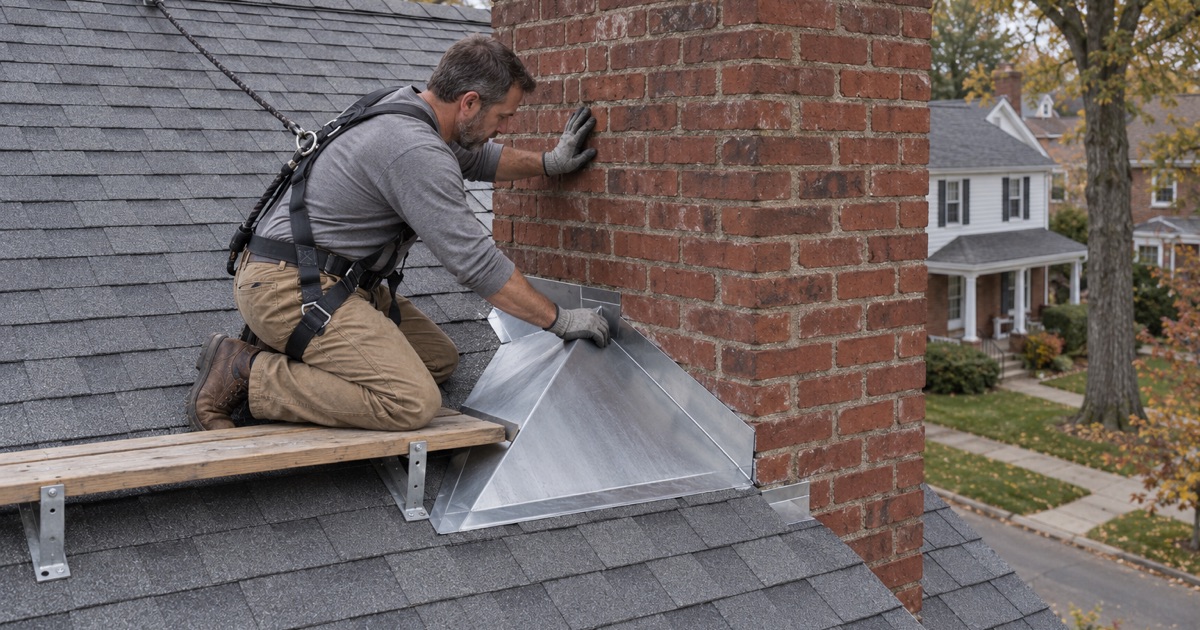
On the sides of a chimney, the roof is sealed with step flashing: individual L-shaped pieces of metal woven in with each course of shingles. Each piece laps the one below it, so water running down the slope is passed from piece to piece and onto the shingle surface rather than into the deck.
Step flashing only works when every piece is present and lapped correctly. When a roof has been layered over or patched in the past, we often find pieces missing, bent flat or buried under roofing cement, and that is where a side-wall leak usually starts.
Counterflashing cut into the masonry
Step flashing alone leaves an open edge against the brick. Counterflashing covers that edge: a second layer of metal set into a mortar joint, often in a cut reglet, and bent down over the step pieces. The two layers can move independently as the house and chimney expand and contract.
The weak version is counterflashing glued to the face of the brick with a bead of sealant. It may look tight on the day it goes on, but sealant on masonry dries, shrinks and lets go. A properly set counterflashing is tied into the joint itself and does not depend on caulk to stay closed.
Apron flashing at the front
At the downhill face of the chimney, an apron flashing carries water off the brick and out onto the shingles below. It has to lap over the roofing, not tuck under it, and it has to turn the corners cleanly to meet the step flashing on each side.
Corners are where an apron most often fails, especially on older work where it was cut short or folded by hand. We check that the corners are closed and that the apron sits under the counterflashing above it, so there is no gap for wind-driven rain to find.
Why flashing is replaced, not caulked
When we redo a roof, the flashing at the chimney comes off with the old shingles and new metal goes in. We do not leave old flashing in place and smear sealant over it. Caulk is a short-term patch, and on a chimney it hides the real condition of the joint until the next leak.
The same rule applies at sidewalls, skylights and valleys, but on these houses the chimney is usually the detail that matters most. New step flashing and counterflashing installed with the new roof means the most leak-prone seam on the house starts its life at the same time as the shingles.
Crowns, Mortar and the Cricket Behind the Chimney
The crown at the top
The crown is the cap of mortar or concrete at the top of the chimney, shaped to shed water away from the flue. When it cracks, water gets into the brick from above and works down inside the masonry, sometimes appearing at the roofline as if the flashing were to blame.
We look at the crown whenever we are on a roof with a chimney. If it is cracked or broken, we tell you what we see and whether it should be repaired before new flashing goes on. Setting fresh metal against a chimney that is taking water from the top would only move the problem.
Mortar joints at the roofline
The mortar joints just above the roof surface do two jobs: they hold the brick together, and they hold the counterflashing. If the joints are soft, sandy or missing, the counterflashing has nothing solid to grip and will pull loose no matter how well it is bent.
When joints at the roofline are worn, they need to be repointed before or as part of the flashing work. We point that out in the estimate rather than leaving it as a surprise, so you can decide how to handle the masonry before the roof goes on.
The cricket behind a wide chimney
On the uphill side of a chimney, water and debris collect against the brick. A narrow chimney can shed that with a back flashing, but a wider one needs a cricket, also called a saddle: a small peaked section framed behind the chimney that splits the flow and sends it around both sides.
Many older chimneys were built without one, or with a cricket too small for the width of the stack. When a chimney is wide enough to trap water behind it, we recommend framing and flashing a cricket as part of the re-roof, because that pocket is where leaves sit, snow lingers and water backs up under the shingles.
Re-Roofing Around a Chimney in Haddon Township
What the written estimate shows
Our written estimates list tear-off, decking, underlayment, flashing, ventilation and gutters on separate lines. On a house with a chimney, the flashing line spells out what is being installed: step flashing, counterflashing, apron and any cricket, so you can see exactly what you are paying for at the chimney.
That breakdown also makes it easy to compare two bids. If one estimate quietly reuses old chimney flashing and another replaces it, a single line item makes the difference visible instead of buried in one lump price.
Decking and underlayment near the chimney
Decking beside a chimney is often the first wood on a roof to rot, because that is where a slow leak has been working the longest. Any rotted sheets we find once the old shingles are off are photographed and shown to you before we replace them, at a per-sheet price already set in the contract.
Around the chimney we lay self-adhering ice and water barrier meeting ASTM D1970 under the shingles and turned up the brick under the flashing. It adds a second seal at the joint that most often leaks, behind the metal rather than in place of it.
Daily cleanup and the right shingle color
Masonry work and tear-off both leave debris, and an older lot with mature plantings near the house can hide a lot of it. The yard, driveway and gutters are cleaned at the end of every work day, and we run a magnet sweep for roofing nails before we leave.
Shingle color is chosen against the real house. On a brick home, the chimney itself is part of the palette, so we hold samples up on site next to the brick and siding rather than picking from a small chip in a catalog.
Contracts written to New Jersey rules
Our contracts follow New Jersey’s home improvement rules, including the notice of your right to cancel. Everything we discussed at the chimney, from new flashing to a cricket to any masonry repair we recommend you arrange first, is written into the agreement so nothing depends on memory.
If a storm damages the roof or the chimney flashing, we photograph and document the damage for your own insurance claim and can meet the adjuster on site when you ask. The goal is the same either way: a roof and a chimney joint that keep water out together.
- 20+ Years in Business
- Line-Item Written Estimates
- NJ and PA Contracts