Gloucester Township Roofing approaches roofing in Gloucester City with more than 20 years behind us and one working assumption: on an old house, the roof you can see is rarely the only roof that has ever been up there. Before any figure is written down, we want to know what sits underneath, how the deck has held up and where water has been finding its way in.
A leak call gets two inspections, not one. We go into the attic as well as up on the roof, because a stain on a bedroom ceiling can sit several feet from the spot where water actually crosses into the house. Tracing it to the true entry point is what lets us tell you plainly whether a repair will hold or whether replacement is the honest answer.
This page covers what changes about that work on the city’s older houses. Age is the common thread. It decides what we expect to find under the shingles, how carefully a tear-off has to go and how much attention the edges against brick will need before a new roof can be trusted.
Washington Mills and the Houses Built for Its Workers
Gloucester City grew up around its mills. In the early 1840s David S. Brown bought land along the Delaware River, built the Washington Mills complex on the riverfront and sold building lots in town. The 1886 county history places the mills between Ellis Street and the river, bounded by Mercer, King and Monmouth Streets.
Brown also built the Mill Block Houses for the people who worked in his mill. The Gloucester City Historical Society counts them among the oldest buildings in the city, and they stand between King Street and Ellis Street. The Mill Block homes were refurbished in the 1980s, a reminder that even the oldest houses here have already been through more than one round of work.
A mill family’s house from the 1800s
The mills kept growing after Brown’s start. The Gloucester Manufacturing Company was chartered in 1845 and built its works in 1850, and like the Gloucester Print Works it employed about three hundred people. That workforce needed places to live, and by 1886 the city’s 1,137 houses were owned by 675 people.
Many of those owners were working families. The 1886 county history credits the Land Company with terms that enabled many with limited income to own their houses. A house bought that way has likely passed through a long line of owners since, each with a different budget and a different idea of what a roof repair should look like.
What the records can and cannot tell us
The records from that era describe the mills, the companies and who owned the houses. They say nothing about how any particular roof was built or what covers it today, and we do not guess. A house on one of the mill-era streets gets the same first visit as any other: attic, roof surface, edges, then a written answer.
That honesty runs both ways. If an old roof still has years left in it after a repair, we say so before anyone mentions tearing it off. If it does not, you hear the reasons in plain terms and see them laid out on the estimate rather than delivered as a sales pitch.
Looking for roofing closer to Collingswood? See Roofing Services in Collingswood.
What Earlier Roofs Leave Behind
A house that has stood for well over a century has almost certainly been re-covered more than once. Each crew that worked on it made its own choices, and some of those choices may still be up there. Earlier coverings left under newer shingles, patched board sheathing and old repairs nailed over older ones are what age makes likely, though no record says what any single roof holds.
Tear-off on an old house
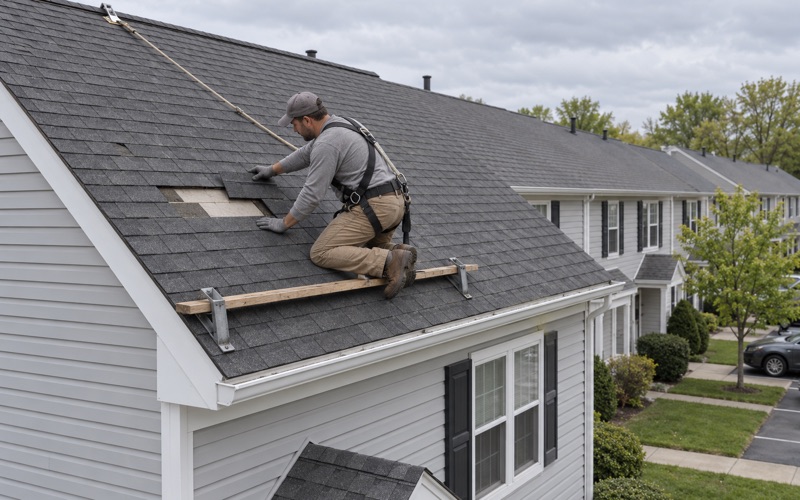
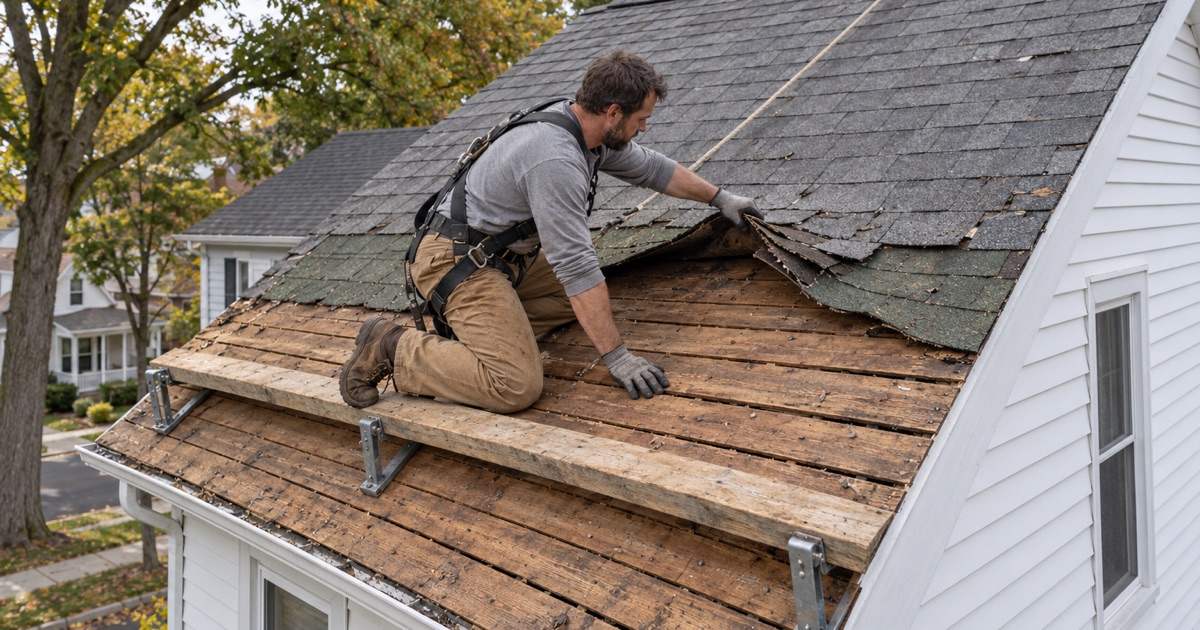
We strip an old roof down to the deck instead of laying new shingles over whatever is already there. Going over existing layers hides the condition of the wood and adds weight to framing nobody has looked at in decades. Taking everything off is the only way to see what the new roof will actually be fastened to.
The tear-off itself goes slower on these houses. Old fasteners, brittle wood and edges reworked by several earlier crews all need care, and we would rather spend an extra hour than crack a board that did not need replacing. Debris goes straight down into the dumpster, not over the gutters and onto the plantings.
Decking found under the shingles
Once the old coverings are off, the deck is out in the open for the first time in years. Older houses often have solid board sheathing rather than plywood, and boards that have taken water at a leak point or along an eave can be soft, split or cupped. Sound boards stay; failed ones come out.
Any rotted decking we find is photographed and shown to you before a single piece is replaced. The price per sheet is already fixed in the contract, so the discovery changes the quantity on the bill and nothing else. You see the damage and the count, and you are never asked to approve a surprise number while standing in the driveway.
Underlayment over an uneven deck
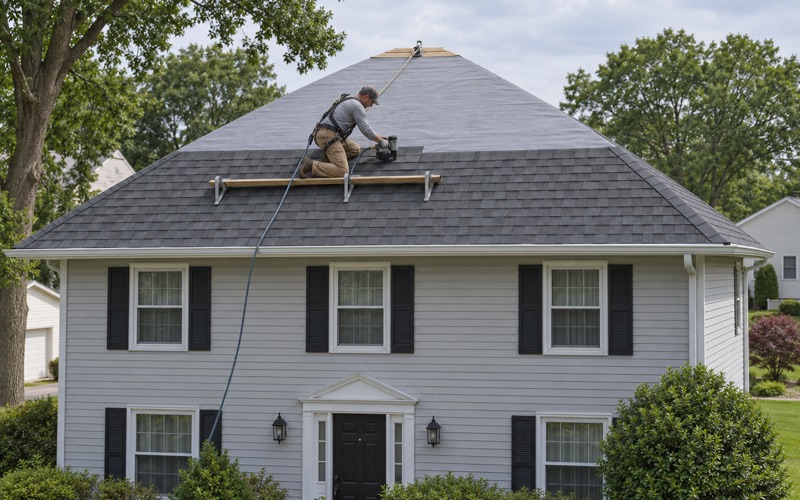
Board decks on old houses are rarely perfectly flat, and the underlayment has to work with that. We use ASTM D1970 self-adhering ice and water barrier along the eaves and in the valleys, where water collects and backs up, with ASTM D8257 synthetic underlayment across the rest of the field. Drip edge goes on at the eaves and rakes so the edge of the deck is never left exposed.
Where an Old Roof Meets Brick and Chimneys
On an older house the roof rarely ends cleanly. It runs up against brick walls, around chimneys and along sidewalls, and those joints are where the age of a house tends to show first. Flashing set into masonry generations ago may have been resealed many times over, sometimes with tar, sometimes with caulk and rarely with new metal.
Replacing flashing instead of sealing it
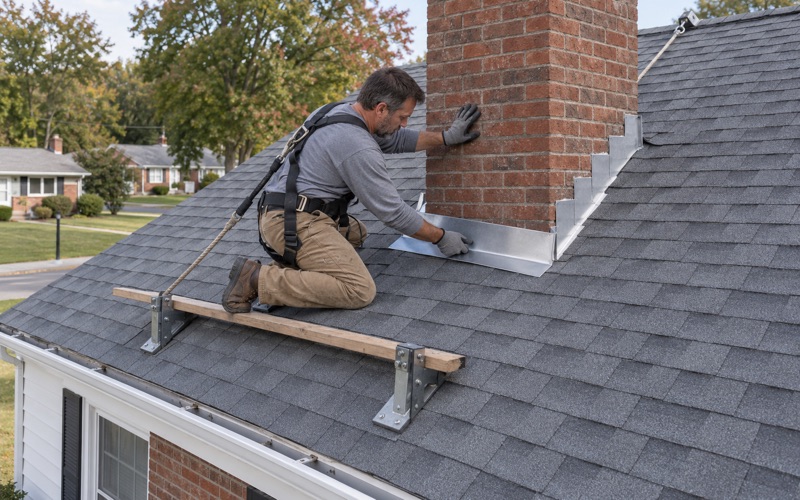
When we redo a roof, the flashing at chimneys, sidewalls, skylights and valleys is replaced. We do not run a bead of caulk over tired metal and call it finished, because caulk on an old joint buys a season or two and then lets go. New step flashing goes in course by course along walls, with counterflashing set into a reglet cut into the brick.
Behind a wide chimney, a cricket (sometimes called a saddle) splits the water that would otherwise pool against the back of the masonry. Where a roof edge dies into a wall, kick-out flashing turns water into the gutter rather than down the face of the wall. Both are small parts that do a great deal of work on a house this age.
Tracing a leak at the brick line
Leaks along a wall or chimney are among the hardest to read from inside a room. Water can enter at a gap in the flashing and travel along the framing before it shows anywhere. Our attic inspection is how we sort out whether the roof is the problem at all, or whether the water is coming through masonry above the roof line.
If the masonry itself needs work, we tell you so and keep our own job to the roof. We would rather point you toward the right trade than cover a brick problem with roofing materials and watch the same stain come back after the next hard rain.
Choosing a shingle color against old brick
Brick that has weathered for a century has its own color, and a shingle that looks right in a brochure can clash with it. We bring samples to the house and hold them up against the actual brick, stone or siding in daylight before you choose. Architectural shingles such as GAF Timberline HDZ, Owens Corning Duration and CertainTeed Landmark come in enough blends to find one that suits.
Pre-1940 Houses Beyond the Mill Streets
The mill-era blocks are only the oldest layer. According to the Census Bureau’s 2024 five-year American Community Survey, 2,017 of Gloucester City’s 4,450 housing units were built in 1939 or earlier. That is close to half the housing in the city, so the conditions described above are not confined to a few historic streets.
An estimate you can compare line by line
Our written estimates separate tear-off, decking, underlayment, flashing, ventilation and gutters into their own lines. On an old house those costs can move independently of each other, and seeing them apart is how you compare our bid with another contractor’s on equal terms. A single lump sum hides which parts of the job a bidder plans to skip.
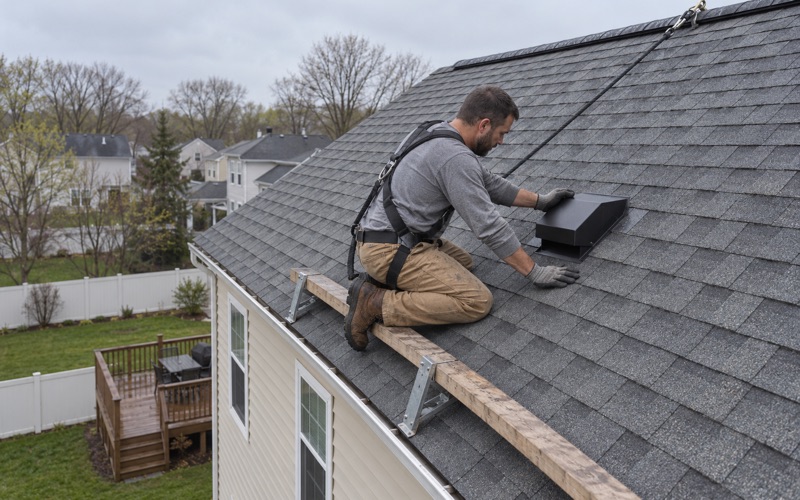
Ventilation earns its own line on these houses. Older attics were often not built with modern shingles in mind, and a ridge vent paired with soffit intake, sized by net free area, keeps heat and moisture from working on the new roof from below. Where an old soffit cannot take intake vents, we walk you through the options before any work starts.
Gutters get the same scrutiny. Old hangers pulled loose over decades can let a gutter sag away from the fascia, and a new roof deserves a clean path for its water. Where replacement makes sense, seamless aluminum gutters and downspouts are priced on their own line, so you can take them or leave them.
Storms and the paperwork that follows
Gloucester City sits in National Weather Service forecast zone NJZ018, Camden, covered by the Mount Holly office. When a storm passes through and shingles come off, we photograph the damage and write it up so you have something solid to file with your own insurance company. If you want us there when the adjuster visits, we will meet them on site.
Contracts, solar panels and the end of each day
Every contract we write for a New Jersey house follows the state’s home improvement rules, including the notice that explains your right to cancel. If panels sit on the roof, their removal and reinstall is planned with the solar company well ahead, so the day of the tear-off holds no surprises for anyone.
At the end of each work day the yard, driveway and gutters are cleaned, and a magnet sweep picks up stray roofing nails before anyone walks across the lawn. When you call about an older roof in the city, the first visit is about finding out what is really there, and every decision after that rests on it.
- 20+ Years in Business
- Line-Item Written Estimates
- NJ and PA Contracts