Gloucester Township Roofing handles flat roof repair in Gloucester Township, NJ, serving surrounding cities including Pine Hill, Bellmawr, Woodbury, Haddonfield and Mantua, with more than 20 years of experience on low-slope roofs of every common type. We repair flat roofs over porches, rear additions, garages, rowhouses and commercial buildings, matching each repair to the membrane already on the roof.
Flat roofs are not really flat; they are built with just enough slope to move water toward a drain, gutter or scupper. When that slope fails, or when a seam opens, water sits on the roof instead of leaving it, and leaks follow. A flat roof leak can also travel a long way under the membrane before it shows on the ceiling below.
We find the actual entry point before patching, check the drainage that keeps the roof dry, and give you a written estimate with each part of the repair on its own line. If the roof has reached the point where repairs no longer make sense, we tell you, with photos that show why.
Flat Roof Materials We Repair
EPDM Rubber Roofs
EPDM is a black synthetic rubber membrane used on many porch roofs, additions and commercial buildings. It fails most often at seams, where the adhesive or tape has let go, and at flashings around walls, curbs and pipes.
We clean and prime the area, then repair with EPDM patches, seam tape and molded accessories designed for rubber roofs. Patching EPDM with asphalt-based products, a common mistake, damages the rubber and makes the next repair harder.
TPO and PVC Single-Ply Roofs
TPO and PVC are white or light-colored single-ply membranes with heat-welded seams. They fail at welds that were never fully fused, at punctures, and where the membrane has shrunk and pulled at the edges.
We repair them by hot-air welding new membrane over the damaged area after cleaning the old surface, since adhesives alone do not bond reliably to these sheets. Each repaired seam is probed once it cools.
Modified Bitumen and Built-Up Roofs
Modified bitumen, applied by torch or as a self-adhered sheet, and older built-up tar-and-gravel roofs are common on rowhouses and older commercial buildings. They develop blisters, cracks and open laps as the asphalt ages under sun and heat.
We cut out blisters, repair laps, and patch with compatible modified bitumen, choosing a torch-free method where open flame is not appropriate near walls, wood trim or neighboring buildings.
Roof Coatings on Older Flat Roofs
Many Philadelphia-area rowhouses and older porches carry aluminum or silver roof coatings that have been reapplied for years. Coatings help reflect heat, but they hide cracks and cannot fix a failing membrane underneath.
We check what is under the coating before recommending another coat, so you do not spend money sealing in a roof that needs repair or replacement.
Common Flat Roof Problems
Ponding Water
Water that stands for days after rain is the biggest enemy of a flat roof. It adds weight, speeds up aging of the membrane, and pushes into every weak seam. Ponding often comes from sagging framing, clogged drains or insulation that has compressed.
Where the structure allows, we correct low spots with tapered insulation or crickets that direct water toward drains, rather than patching the same puddle every year.
Seams, Blisters and Splits
Seams and laps are where most flat roof leaks start. Blisters form when moisture or air trapped under the membrane expands in the heat, and splits appear as old membranes shrink and become brittle.
We repair each defect with compatible materials and look for the cause, such as trapped moisture or movement in the deck, so the same spot does not fail again.
Flashing at Walls and Parapets
Where a flat roof meets a wall, a parapet, or the main house, the membrane turns up the wall and is covered by counterflashing. When that counterflashing pulls loose, or the masonry above it cracks, water runs behind the membrane.
We reset or replace the counterflashing, cut a fresh reglet where needed, and tell you when the leak is coming through the masonry itself rather than the roof.
Drains, Scuppers and Gutters
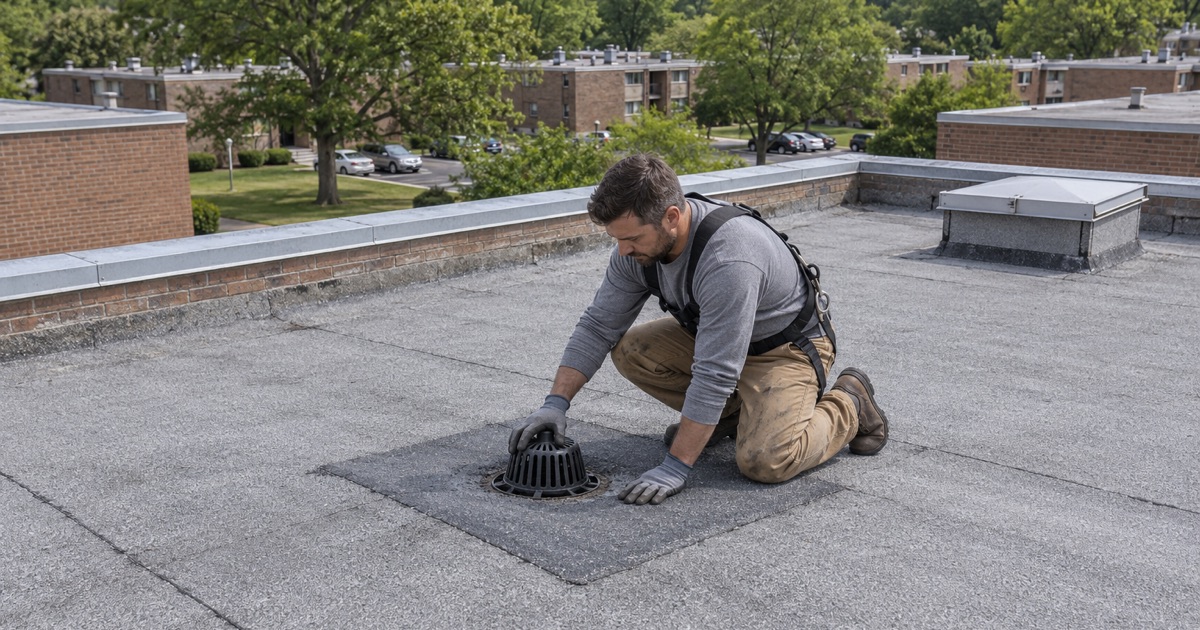
Clogged drains and scuppers back water up onto the roof, and failed drain clamping rings let it leak around the drain body. We clear and repair drains, scuppers and the gutters and leaders that carry water away from the roof edge.
On porch roofs and additions, the gutter at the low edge is often the only exit for water, so a single clog can back water up under the membrane edge. We check that the edge metal laps into the gutter correctly and that the gutter is sized for the area it drains.
Repairing or Replacing a Flat Roof
When Replacement Makes More Sense
When the membrane has lost adhesion over large areas, the insulation underneath is wet, or new leaks keep appearing in different places, repairs stop paying off. We price replacement alongside repair so the decision rests on real numbers.
A replacement also lets us correct drainage, add insulation and choose a membrane suited to how the roof is used, such as one that handles foot traffic or reflects summer heat.
Permits and Paperwork
In New Jersey, re-covering the roof of a detached one- or two-family house is ordinary maintenance under N.J.A.C. 5:23-2.7, while attached homes, multifamily and commercial buildings need permits. Pennsylvania townships each apply their own rules, which we check for your address before quoting.
Every flat roof job is contracted under the home improvement rules of the state the building sits in, New Jersey or Pennsylvania, including the right-to-cancel notice. In New Jersey a repair is taxable, while a complete new roof can be documented as an exempt capital improvement on Form ST-8.
- 20+ Years in Business
- Line-Item Written Estimates
- NJ and PA Contracts