Gloucester Township Roofing provides emergency roof repair in Gloucester Township, NJ, serving surrounding cities including Pine Hill, Bellmawr, Woodbury, Haddonfield and Mantua, backed by more than 20 years of responding to wind, storm and tree damage on homes and commercial buildings. When water is coming in, we work to stop it first and plan the permanent repair second.
An emergency call is not the time for a sales pitch. Our first job is to make the roof watertight with a tarp or temporary seal, protect what is inside, and document the damage. Once the weather clears, we come back, open the damaged area and repair it properly with materials that match your roof.
The township has seen National Weather Service confirmed EF1 tornadoes, one in June 2019 that crossed from Deptford into the Blackwood section and another in June 2022, so wind damage here is not hypothetical. Neither is a limb through a roof after a summer thunderstorm, or an ice dam that sends water down an exterior wall in February.
What Counts as a Roofing Emergency
Wind and Storm Damage
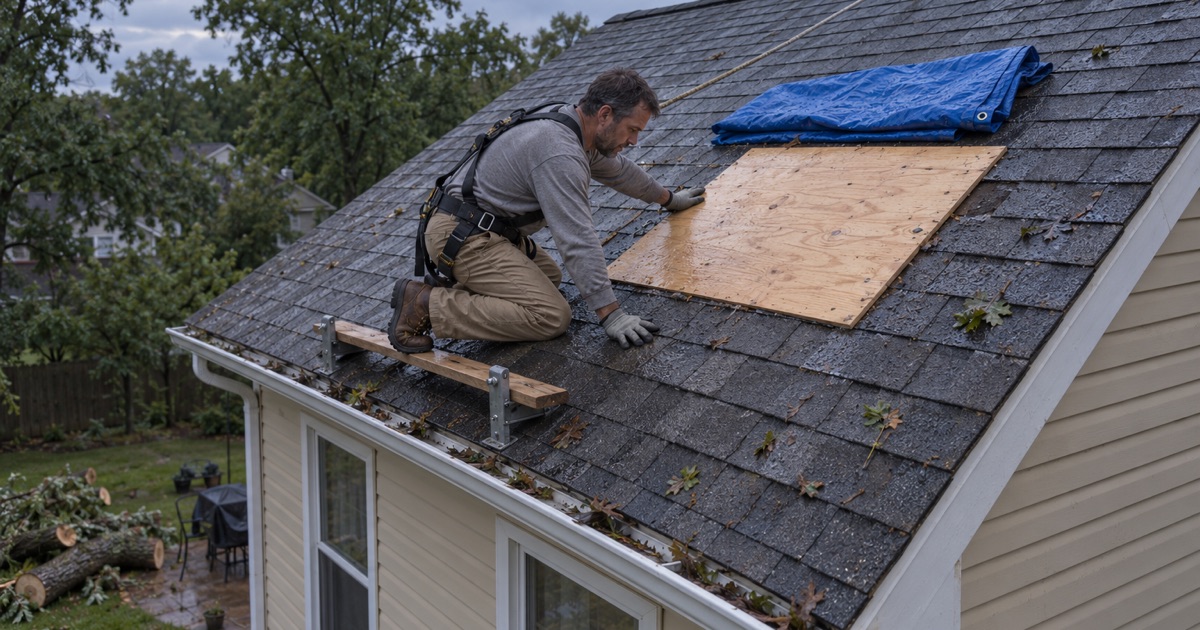
High winds lift shingle edges, break the seal strips and tear whole sections away, leaving underlayment or bare decking exposed. Ridge caps and flashing can be peeled back in the same storm, opening the roof at its most vulnerable points.
If you see shingles in the yard or a patch of a different color on the roof after a storm, have it checked before the next rain. Exposed underlayment can hold off water for a short time, but it was never meant to be the roof.
Fallen Trees and Limbs
A falling limb can crack shingles, puncture the deck, or break rafters outright. Even a branch that seems to have bounced off can leave a hole hidden under debris or a crushed section that will leak in the next storm.
When a tree is still resting on the roof, call a tree service to remove it before anyone climbs up. Once it is clear, we cover the opening, check the framing beneath it, and tell you what the structural repair will involve.
Active Leaks and Sagging Ceilings
Water dripping through a light fixture, a ceiling bulging with trapped water, or a steady drip that will not stop are emergencies whatever caused them. Water spreads through insulation and drywall quickly and ruins far more than the spot where it first appears.
We trace the leak from the attic to its entry point so the temporary repair covers the right place. Tarping the wrong slope is a common mistake when crews skip the attic in a hurry.
Temporary Protection
Tarping and Emergency Sealing
We cover the damaged area with a heavy tarp that extends over the ridge where possible, secured with wood battens fastened to the roof so wind cannot work under its edges. Small openings may be closed with a temporary patch of underlayment and sealant instead.
We avoid nailing through undamaged shingles where we can, so the temporary fix does not create new holes that need repair later. Every tarp is photographed in place for your records.
Protecting the Inside of the House
While we work on the roof, you can limit interior damage by moving furniture and electronics, catching water, and draining a bulging ceiling into a container through a small hole. Turn off the circuit to any fixture with water coming through it.
If insulation in the attic is soaked, it should be pulled and replaced once the roof is closed, since wet insulation stays wet for weeks and feeds mold. We note it in our report so it is included in your claim.
After the Storm: Permanent Repair and Insurance
The Permanent Repair
Once the weather allows, we remove the tarp, open the damaged area, and replace broken decking, underlayment, shingles and flashing. Decking found to be rotted or broken is photographed and shown to you before replacement at the per-sheet price written into your contract.
When storm damage is widespread on an older roof, a full replacement may make more sense than a large patch. We give you both prices and a plain explanation so the choice is yours to make.
Documenting Damage for Your Claim
Storm damage is photographed and written up for your own insurance claim, with dated images of the roof and the interior. We describe fresh storm damage and older wear separately and honestly, since an inflated report tends to hurt a claim rather than help it.
When you ask, we meet the adjuster on site and point out what we found. We do not negotiate claims; in New Jersey and Pennsylvania that is the work of a licensed public adjuster under N.J.S.A. 17:22B and 63 P.S. 1601.
Claim Timelines in New Jersey and Pennsylvania
New Jersey regulations under N.J.A.C. 11:2-17 require an insurer to acknowledge a claim within 10 working days and to pay within 30 calendar days of a properly executed proof of loss, or explain in writing why it needs more time. Pennsylvania’s rules in 31 Pa. Code Chapter 146 require acknowledgment within 10 working days and a decision within 15 working days of proof of loss.
Knowing these timelines helps you keep your claim moving. Report damage promptly, keep copies of everything you send, and note the dates of every call.
Storm Chasers and Your Contract Rights
After a big storm, out-of-area crews often go door to door. Ask any roofer for a state registration number, a certificate of insurance and a written, itemized estimate before signing anything.
In New Jersey a home improvement contract can be cancelled until midnight of the third business day after you receive it, and Pennsylvania’s Home Improvement Consumer Protection Act gives the same three business days. Our contracts include those notices.
- 20+ Years in Business
- Line-Item Written Estimates
- NJ and PA Contracts