Gloucester Township Roofing brings more than 20 years of experience to roofing in Darby, and on this side of the river the first thing we think about is often the paperwork rather than the shingles. When roof work lands alongside other repairs on the same house, the figure on our estimate can end up inside a larger calculation the owner never expected to make.
That is why our written estimates are built the way they are. Tear-off, decking, underlayment, flashing, ventilation and gutters each sit on their own line, so the roofing share of a bigger project is visible at a glance instead of buried in one lump sum. An owner, a general contractor or a borough official can see exactly what the roof costs and why.
Before any of that, we give a plain answer on whether the roof can be repaired at all. A repair that solves the problem is almost always the smaller number, and on some Darby houses a smaller number matters more than usual. The sections below explain why, and what it means for planning roof work in this borough.
Darby Creek, Ordinance 774 and the 50 Percent Rule
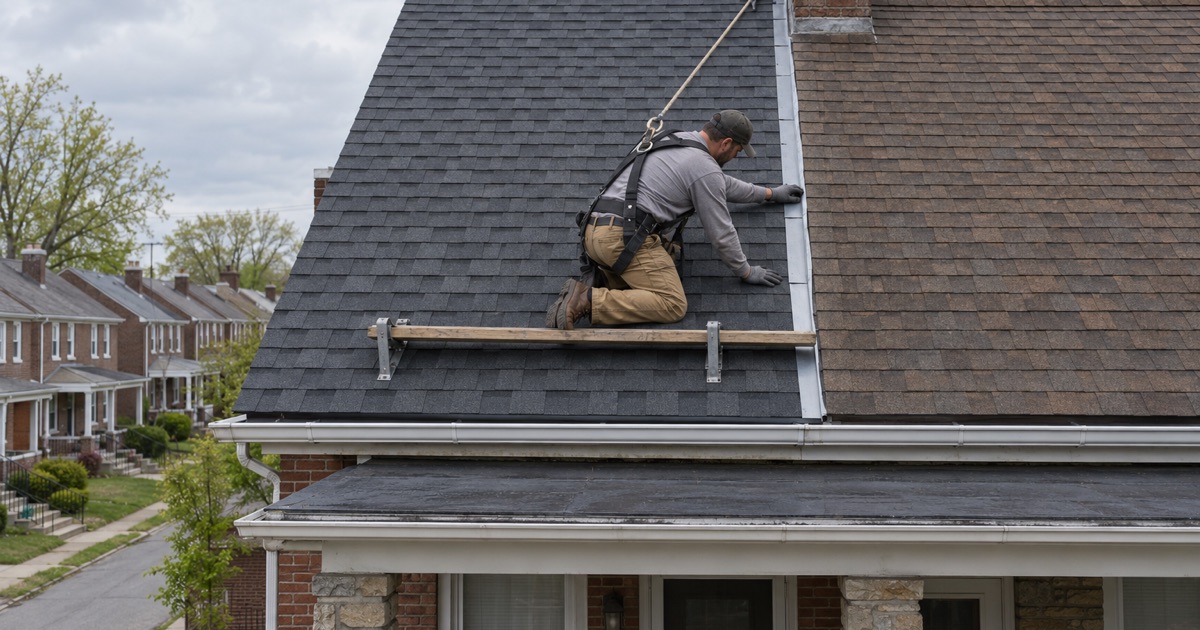
A permit rule written for the whole borough
Darby is a borough of 0.84 square miles in Delaware County, incorporated in 1853 and set along Darby Creek about five miles southwest of Center City Philadelphia. It is a separate municipality from Darby Township and Upper Darby Township, and everything described on this page is the borough’s own rule, not a neighbor’s.
On August 19, 2015, the borough’s floodplain management ordinance, Ordinance 774, took effect. As enacted, it makes it unlawful to undertake any construction or development anywhere in Darby without a permit from the Floodplain Administrator, a role it assigns to the Borough Manager. The one carve-out is for minor repairs, defined as replacing existing work with equivalent materials for routine maintenance and upkeep.
What counts as a substantial improvement
Inside the identified floodplain, meaning the Special Flood Hazard Area on the flood insurance rate maps dated November 18, 2009 or their most recent revision, the ordinance draws a firm line. Any modification, reconstruction or improvement costing 50 percent or more of a building’s market value is a substantial improvement, and the building must then fully comply.
Work below that line is not simply waved through. The ordinance says it should be elevated or floodproofed to the greatest extent possible. Permit applications must also break out the flood-related share of the estimated cost and state the building’s market value before the flood damage, which is exactly where a cleanly itemized roofing figure earns its keep.
Where roofing enters the arithmetic
FEMA’s national guidance on substantial improvement, written for property owners, contractors and design professionals, lists the costs that count toward that threshold. Under structural elements and exterior finishes it names roofing, gutters and downspouts, alongside materials, labor, demolition, debris disposal and contractor overhead and profit. Clean-up, permit fees, plans and surveys are among the costs it excludes.
That list is federal guidance rather than a Darby form, and the borough’s own review decides how any building is treated. We make no determination about market value or substantial improvement for anyone. What we can do is hand over a roofing number clear enough that whoever does make that call is not left guessing at it.
Looking for roofing closer to Yeadon? See Yeadon Roofing.
Why a Roof Estimate Belongs in a Flood-Repair Budget
Darby Creek has a long record of leaving its banks. After Hurricane Floyd in 1999 the borough tore down more than 90 houses. During Tropical Storm Isaias on August 4, 2020, the creek swelled to more than a dozen times its normal width, crested at a level reported as rivaling Floyd, and closed the Chester Pike bridge.
On December 18, 2023, residents of the 900 block of Springfield Road were evacuated as the water rose again. None of those reports ties the flooding to roof damage, and we would not suggest otherwise. The connection is financial: when a house needs flood repairs, roof work planned for the same season can fall into the same cost picture.
Timing a re-roof around other repairs
An owner restoring a flooded first floor often decides it is a sensible moment to deal with an aging roof as well. That instinct is reasonable. On a house in the mapped floodplain, though, it is worth learning how the combined total compares with the building’s value before contracts are signed, because the ordinance weighs the whole project rather than one trade.
We do not know where any particular house sits on the flood maps, and nobody on our crew should guess. The Floodplain Administrator and your own design professional answer that question. Our part is getting you a roof estimate early enough, and detailed enough, that it can be added to everything else before work starts rather than after.
Repair first, replacement second
Because the total can matter here, our first question on any Darby roof is whether a targeted repair will do the job. Every leak call includes a look in the attic as well as on the roof, so the water is followed to the spot where it actually gets in before anything is priced. Fixing one failed valley costs far less than a full tear-off.
When a roof genuinely has reached the end of its life, we say so and show you why. Either way, the written figure separates each part of the work, so a second contractor’s bid can be compared item by item and you can see which pieces of the job could reasonably wait.
Ten Years of Repair Costs on One Building
Ordinance 774 does not judge each repair in isolation. Before permitting work on an existing structure, the Floodplain Administrator reviews the building’s repair history so repetitive loss concerns are addressed. The borough also tracks damage and repair amounts over a rolling period of 10 years to catch cumulative substantial damage.
Repetitive loss, in the ordinance’s definitions, means flood-related damage on occasions within a 10-year period whose cumulative repair cost equals or exceeds half of market value. A building that meets it is treated as substantially improved regardless of the actual repair work performed, so the history of a house can weigh as much as the job in front of it.
Keeping your own paper trail
For an owner on the Darby Creek floodplain, that makes records worth keeping. Every estimate, invoice and scope of work from the last decade tells part of the building’s story, and a roofing bill should be easy to separate from the flood-related costs around it. Our paperwork carries dates and line items written to make sense when someone reads them years later.
Showing what the old roof was hiding
Tear-offs on older houses often uncover rotted decking nobody could see from the ground. When we find it, we photograph it and show it to you before replacing a single sheet, and the per-sheet price is fixed in the contract ahead of time. That keeps a surprise from quietly inflating a total that might later be read against a threshold.
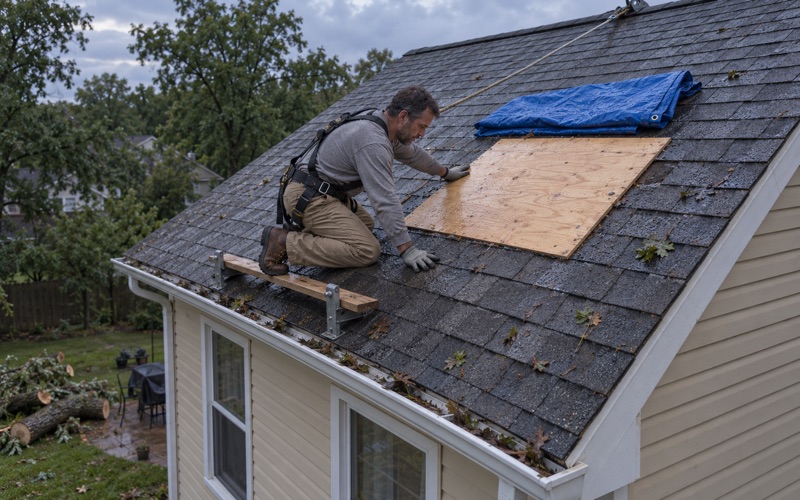
Storm damage gets the same documentation. We photograph it and write it up for your own insurance claim, and a crew member will meet the adjuster on site if you ask. The claim itself stays entirely yours; we supply the photographs and the roofing facts, and nothing beyond them.
Roof Work on Darby Houses Outside the Mapped Floodplain
Plenty of Darby sits well away from the creek, and the substantial improvement rule applies inside the identified floodplain. The ordinance’s permit requirement, though, is written for construction and development anywhere in the borough. Whether a given roof job is a minor repair or something more is the borough’s question to answer, so we suggest asking it before work is scheduled.
Shared walls and older roofs
Most Darby homes share a wall with a neighbor. Census estimates count 2,906 one-unit attached houses among 4,545 housing units, and four in five units were built before 1960. On a row or a twin, the flashing where one roof meets the next, and at chimneys and sidewalls, does much of the work of keeping water out of the house.
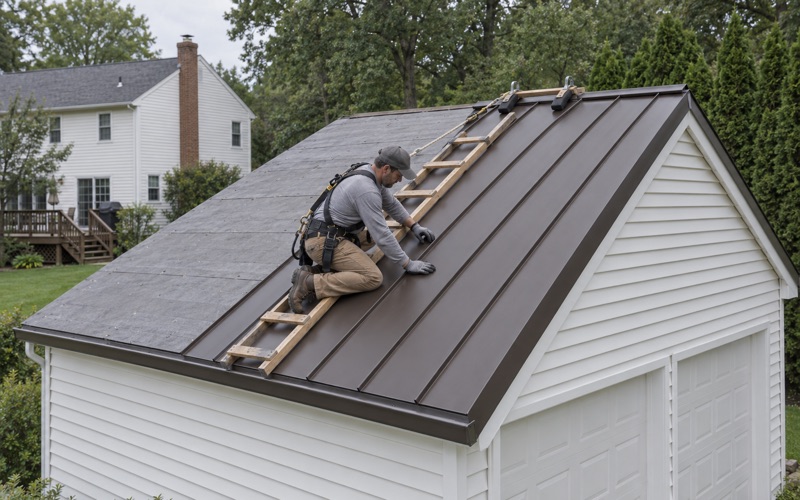
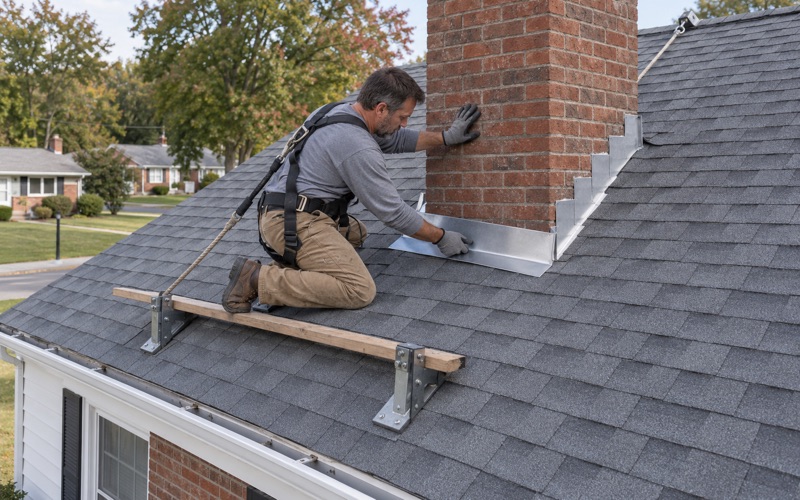
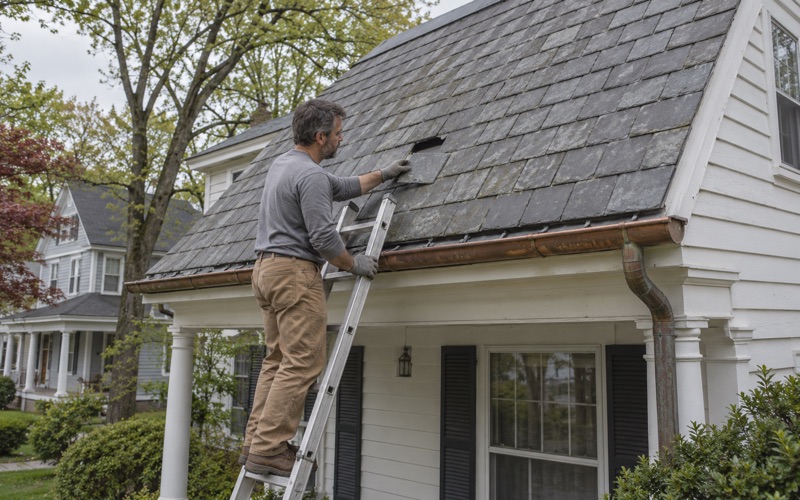
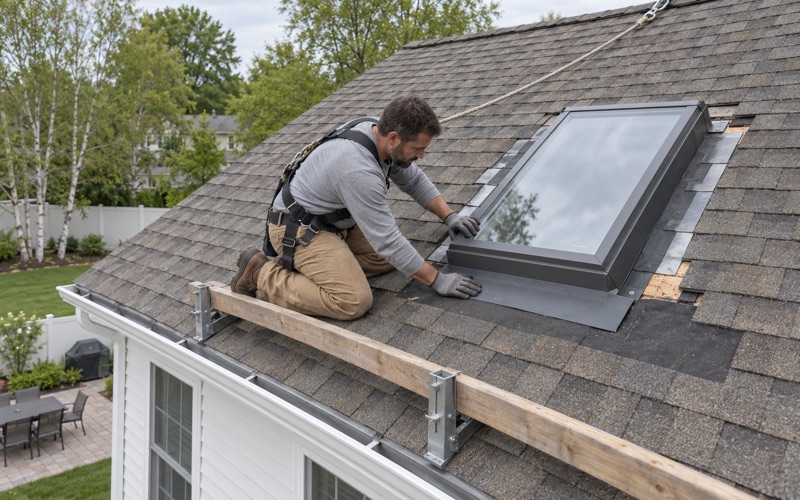
When we redo a roof, that flashing is replaced rather than smeared over with caulk. Step flashing and counterflashing go back in properly at walls and chimneys, and skylight and valley flashing get the same attention. On older slate, repairs use matching slate set with slate hooks wherever matching material can be found, not whatever happens to be on the truck.
Gutters, downspouts and drainage
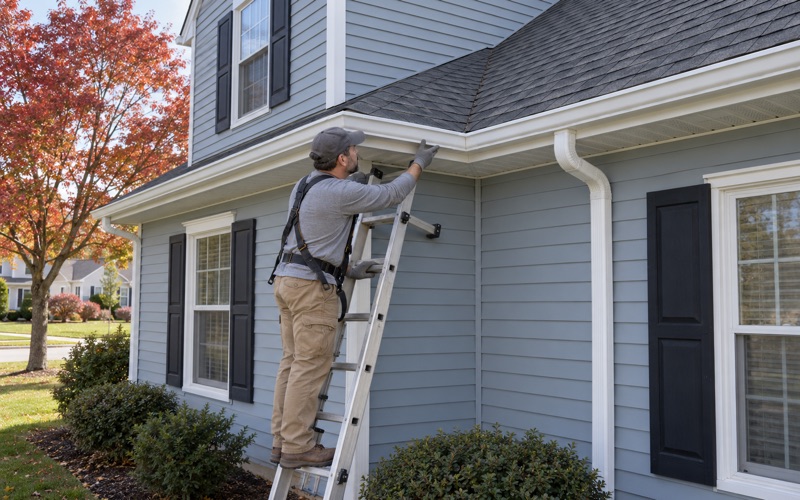
Gutters and downspouts are part of a roof system, not an afterthought bolted on at the end. Seamless aluminum gutters sized to the roof, with downspouts that carry water away from the foundation, appear on most of our replacement estimates as their own line, so you can see exactly what they add to the total.
A clean site and a matched color
Darby lots are compact, with houses close to the sidewalk and to one another. At the end of every work day we clean the yard, driveway and gutters and run a magnet sweep for roofing nails. Shingle color is chosen with samples held up against your actual brick or siding, so the new roof suits the house it sits on.
If you are weighing roof work on a Darby house, flood-related or not, we start with a look at the roof and the attic and a straight answer on repair versus replacement. After that comes a written estimate built so every cost on it is easy to find, whoever ends up reading it.
- 20+ Years in Business
- Line-Item Written Estimates
- NJ and PA Contracts