Gloucester Township Roofing provides commercial roofing in Gloucester Township, NJ, serving surrounding cities including Pine Hill, Bellmawr, Woodbury, Haddonfield and Mantua, with more than 20 years of work on roofs of every kind. We repair, maintain and replace low-slope roofs on retail centers, offices, medical buildings, churches and light industrial properties, along with the steep-slope roofs some commercial buildings carry.
Commercial roofs fail differently from houses. Water ponds instead of running off, rooftop units puncture the membrane in dozens of places, and a leak can travel across the insulation for a long way before it drips into a store or office. Finding and fixing the real source is the whole job.
Our estimates break each project into separate lines for tear-off, insulation, membrane, edge metal, flashing and drainage work, so owners and property managers can compare bids on scope rather than on a single total. When repair will carry the roof for years, we say so before discussing replacement.
Low-Slope Roof Systems We Install
EPDM Rubber Membranes
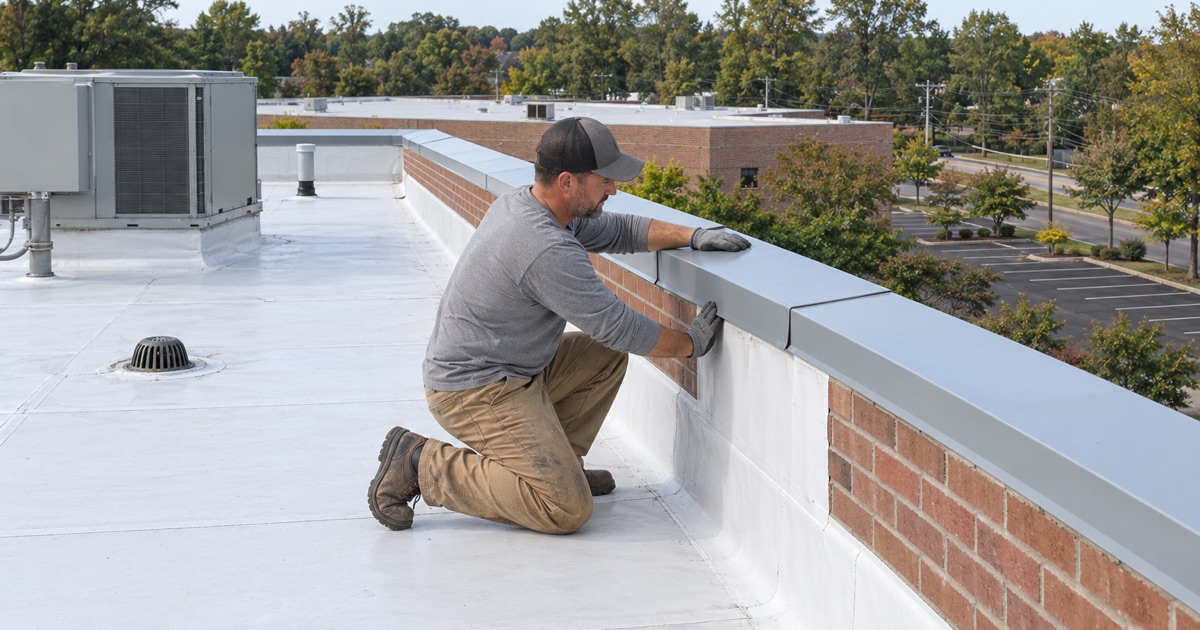
EPDM is a synthetic rubber membrane with a long record on commercial roofs. It stays flexible in cold weather, handles the expansion and contraction of large roof areas well, and is straightforward to repair when it is punctured. We install it fully adhered or mechanically fastened depending on the deck and the building.
EPDM seams are joined with factory-applied tape, and edges and penetrations are finished with molded accessories rather than cut pieces wherever possible. Most EPDM failures we see start at seams and flashings done by hand in a hurry, not in the open field of the sheet.
TPO and PVC Single-Ply Membranes
TPO and PVC are single-ply sheets whose seams are welded with hot air, creating a bond that is often stronger than the sheet itself. Their light surfaces reflect sunlight, which can reduce cooling loads on buildings with large air conditioning demands. PVC also resists grease and chemicals, making it a common choice over restaurant exhaust fans.
Welded seams are probed along their full length after installation, which catches a cold weld before it becomes a leak. We also leave you a record of the membrane and its manufacturer, which matters if a warranty claim is ever needed.
Modified Bitumen Roofing
Torch-down SBS and APP modified bitumen build a thick, multi-layer roof that handles foot traffic around rooftop equipment better than thinner membranes. Self-adhered versions avoid open flame where a torch is not appropriate. We choose the method based on the building, its neighbors and the safety plan for the job.
Modified bitumen is usually finished with a granulated cap sheet that shields the asphalt from sunlight. On older built-up roofs it is often the natural replacement, since it keeps the multi-layer toughness owners are used to.
Commercial Roof Repair and Maintenance
Seams, Blisters and Punctures
Open laps, split seams, blisters and punctures from dropped tools or foot traffic are the most common commercial leaks. We clean and prepare the area, then repair it with membrane and primer compatible with the existing roof, because a mismatched patch will not bond and simply peels away later.
We also look for the cause. Repeated punctures near a rooftop unit usually mean service technicians need a walkway pad, and adding one costs far less than repairing the same spot every season.
Drains, Scuppers and Ponding
Clogged drains and scuppers leave water standing on the roof, adding weight and speeding up wear on every seam it touches. We clear drains on every visit, repair failed drain clamping rings, and correct low spots with tapered insulation or added drainage where the structure allows.
Buildings that drain to the edge get the same attention at their gutters, leaders and downspouts. A leader that empties across a sidewalk freezes into a hazard in winter, so we route discharge where it is safe for customers and staff.
Rooftop Units and Edge Metal
HVAC curbs, exhaust fans, conduit supports and pipe penetrations each need their own flashing, and each one is a potential leak. We reflash curbs, replace pitch pans and refasten loose edge metal and coping, which are often the first parts to fail in a windstorm.
When a unit is being replaced, we coordinate with the mechanical contractor so the curb can be reflashed while it is exposed, rather than having the new unit set on old, failing flashing.
Commercial Roof Replacement
Assessing Repair Versus Replacement
Before recommending a new roof, we check how much of the insulation is wet and how widely the membrane has failed. If damage is limited, targeted repairs and a maintenance plan usually make more sense. When moisture has spread through the insulation, a new roof is the only lasting answer, and we show you the findings behind that conclusion.
We set repair and replacement prices side by side, along with an honest estimate of how long each option should last, so the decision can be made on cost per year of service rather than on the lowest number.
Permits, Inspections and Scheduling
Commercial re-roofing needs permits and inspections in New Jersey, since the ordinary-maintenance exemption covers detached one- and two-family homes only, and Pennsylvania townships each apply their own rules. We plan those steps into the schedule and coordinate with property managers so tenants receive notice before work starts.
On multi-tenant buildings we can phase the work section by section, so only part of the building is affected at any one time and each section is closed up and watertight before the next is opened.
Safety on Commercial Roofs
Crews work under OSHA fall protection rules, with guardrails, warning lines or personal fall arrest systems as the roof requires. On occupied buildings we also protect entrances and parking areas from falling debris, so customers and employees can come and go safely.
Before work begins, we review access, material hoisting and dumpster placement with the owner or manager, so deliveries, customers and our crew are not competing for the same space. Each work day ends with a sweep of the lot and walkways for nails and debris.
- 20+ Years in Business
- Line-Item Written Estimates
- NJ and PA Contracts